
Lucky Gemstone Calculator by Date of Birth : In Indian numerology, your lucky gemstone is the stone of the planet that rules your root number, the single digit you get from the day of the month you were born. Someone born on the 21st has root number 3, ruled by Jupiter, so their stone is yellow sapphire. The calculator below does this in a second and prints every step of the arithmetic, so you can check the answer yourself instead of taking it on trust.
It also does three things most gemstone calculators leave out. It shows the stone you would get if you went by your Bhagyank instead, because many numerologists do. It lists the stones that tradition says should not be worn alongside yours. And it tells you plainly when your two numbers point to stones that are traditionally kept apart, which, as our own count further down shows, happens for about half of all birth dates. Everything on this page describes a traditional belief system, not proven science, and the practical advice about buying a stone stands on its own either way.
Lucky Gemstone Calculator Online Free
Lucky Gemstone Calculator
Enter your date of birth to find your gemstone and see exactly how it was worked out.
Please select your full date of birth.
What Is a Lucky Gemstone in Numerology?
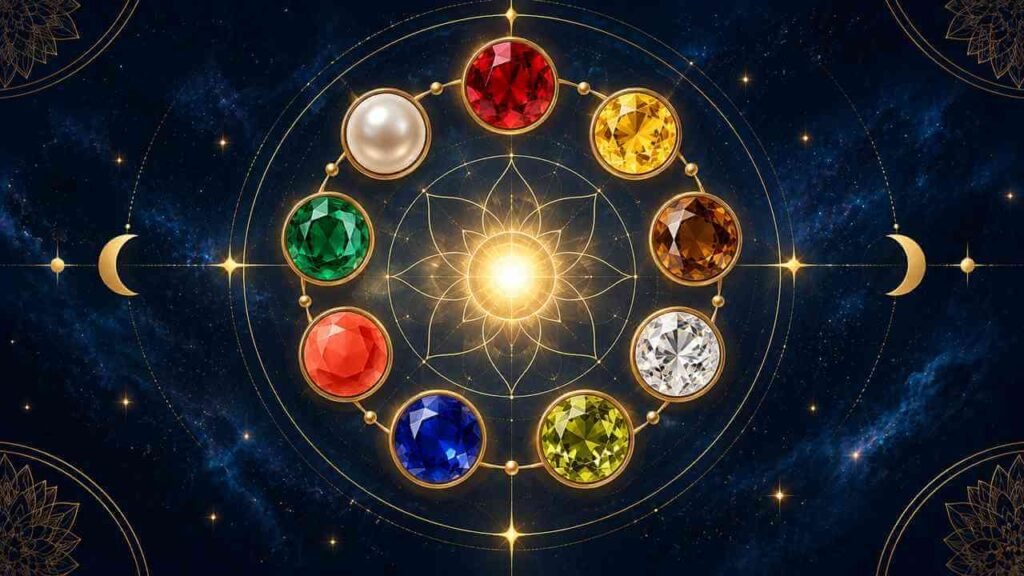
The idea begins with the nine grahas of Indian astrology: the Sun, Moon, Mars, Mercury, Jupiter, Venus and Saturn, plus Rahu and Ketu, the two shadow points where the Moon’s path crosses the Sun’s. Each graha has one gem. A well-known Sanskrit verse, found in texts such as the Jataka Parijata, lists them in order: ruby for the Sun, pearl for the Moon, coral for Mars, emerald for Mercury, yellow sapphire for Jupiter, diamond for Venus, blue sapphire for Saturn, and hessonite and cat’s eye for Rahu and Ketu. Set together in one piece of jewellery, these nine make the navaratna, a design still made across India today.
Numerology adds one link to that chain. It gives each number from 1 to 9 a ruling graha: 1 is the Sun, 2 the Moon, 3 Jupiter, 4 Rahu, 5 Mercury, 6 Venus, 7 Ketu, 8 Saturn and 9 Mars. Your birth day decides the number, the number decides the graha, and the graha decides the stone. That is the whole method, and it is the one this calculator follows.
It helps to know where this method sits. In Vedic astrology proper, a gemstone is usually chosen from the full birth chart, looking at the ascendant, the Moon sign or the planetary period you are running, not from the date alone. Some astrology writers describe the date-of-birth method as a simpler route for people who do not know their exact time of birth. That is a fair way to read this page: a starting point for interest and reflection, not a prescription.
How Is Your Lucky Gemstone Calculated?
Here is a complete worked example. Enter 21 October 1995 in the calculator above and you should see exactly this.
- Root number (Mulank). Only the day counts. The 21st gives 2 + 1 = 3.
- Ruling planet. Root number 3 is ruled by Jupiter.
- Gemstone. Jupiter’s stone is yellow sapphire, called pukhraj in Hindi.
- How it is traditionally worn. Set in gold, on the index finger, and often worn for the first time on a Thursday. The usual affordable alternative is citrine or yellow topaz.
- Supportive stones. The friendly numbers of 3 are 1, 2 and 9, which point to ruby, pearl and red coral. None of the three is on yellow sapphire’s not-worn-together list, so all three are shown.
- Stones kept apart. Hessonite, emerald, diamond, cat’s eye and blue sapphire are the stones tradition does not pair with yellow sapphire.
- The Bhagyank check. Now the whole date counts. Day 21 gives 3, month 10 gives 1 + 0 = 1, and year 1995 gives 1 + 9 + 9 + 5 = 24, then 2 + 4 = 6. Together that is 3 + 1 + 6 = 10, then 1 + 0 = 1. Bhagyank 1 is ruled by the Sun, so a numerologist who works from the Bhagyank would suggest ruby instead. Ruby and yellow sapphire are a traditionally friendly pair, so for this date the two methods do not pull against each other.
Two details are easy to miss. First, the month and year play no part in the main stone: everyone born on the 21st of any month, in any year, gets yellow sapphire. Second, birth days are not spread evenly across the nine stones. Root numbers 1 to 4 each collect four possible days, because the 28th, 29th, 30th and 31st add one each, while 5 to 9 collect only three. That is why ruby, pearl and yellow sapphire turn up a little more often than the others.
A note on names. Many Indian websites call the Bhagyank the “destiny number”. On this site, Destiny refers to the number worked out from your name, so we use the Bhagyank’s other common name, the Life Path number, to keep the two apart.
Why Another Calculator May Give You a Different Stone
If you have tried a few gemstone calculators, you may have been handed a different stone by each one. Usually nobody made an arithmetic mistake. The calculators are answering different questions. Take a single date, 10 April 1992, and run it through the methods you will meet online:
| Method | What it uses | Result for 10 April 1992 |
|---|---|---|
| Root number (Mulank), this calculator’s main result | Birth day only: 1 + 0 = 1, the Sun | Ruby |
| Bhagyank (Life Path number), also shown by this calculator | Whole date: day 1, month 4, year 1992 (1 + 9 + 9 + 2 = 21, then 3). Together 1 + 4 + 3 = 8, Saturn | Blue sapphire |
| Western birth-month list | Month only: April | Diamond |
| An older Western birth-day list (1921) | Birth day: the 10th | Topaz |
Four methods, four stones. The awkward part is that, by the traditional rule explained further down, blue sapphire and diamond are both on ruby’s list of stones not to wear alongside it. Someone who collected “their” stone from three different websites could end up wearing exactly the combination the tradition warns against. Here is where the differences come from.
- Which number counts. Most Indian numerology sites take the stone from the root number, as we do. Some add up the whole date and use the Bhagyank instead, and at least one seller’s guide adds up the whole date and then uses a different set of stones altogether, crystals such as rutilated quartz and amazonite. Our calculator shows both the root-number stone and the Bhagyank stone, so you can see at once whether your two numbers agree.
- Which set of stones. The Western birth-month list, with garnet for January, amethyst for February and so on, is a separate tradition built around months rather than planets. In our own count it gives the same stone as the root-number method for only about 1 in 20 birth dates.
- Which Western tradition. Western numerology once had birth-day stones of its own. A February 1921 column in a New Zealand newspaper, preserved in the National Library of New Zealand’s Papers Past archive, used exactly the same day groups as this page (the 1st, 10th, 19th and 28th together, and so on) but assigned them topaz, moonstone, amethyst, crystal, opal, turquoise, blister pearl, onyx and garnet. Same arithmetic, entirely different stones.
- Which planet rules 4 and 7. Indian numerology gives 4 to Rahu and 7 to Ketu, while Western numerology links them with Uranus and Neptune, and some sites mix the two. Even among Indian sources, 4 is unsettled: most give hessonite, one Indian news site recommends blue sapphire, and a Hindi news site suggests either blue sapphire or hessonite.
- Whether numerology is used at all. A Vedic astrologer would normally choose your stone from your birth chart, and that answer may have nothing to do with your birth date number.
The practical lesson is short. Pick one method, understand why you picked it, and do not combine stones gathered from different calculators.
The Nine Gemstones and What Each Is Believed to Do
Each description below covers what the stone is traditionally believed to support, the kind of person who tends to have that root number, where things are said to go wrong, and one practical point to know before buying. The “goes wrong” part matters. In the tradition, a stone strengthens its planet, and a strengthened planet can overshoot.
Root Number 1: Ruby (Manik), the Sun’s Stone
Ruby is linked with the Sun, and so with confidence, vitality and the willingness to lead. People with root number 1 often recognise themselves in that: they like to decide, and they dislike waiting for permission. The tradition’s warning is the other side of the same coin. Too much Sun is described as pride, a short temper and a habit of treating every disagreement as a challenge to your authority, which is why ruby is treated as a stone to wear with care rather than on impulse. On the buying side, many low-priced “rubies” are heavily treated, and some are lead-glass-filled composites, part ruby and part glass, which should always be disclosed and are not what the tradition means by a ruby. A red garnet, the usual substitute, gives you the colour at a fraction of the price.
Root Number 2: Pearl (Moti), the Moon’s Stone
Pearl belongs to the Moon, which rules the mind and moods in Indian astrology, so pearl is associated with calm, emotional balance and a softer way of dealing with people. Root number 2 people are often the ones who sense how everyone in the room is feeling before a word is spoken. Where it goes wrong is when that sensitivity turns inward: a 2 can read a neutral message as a rejection, go quiet instead of saying what hurt, and then feel unheard. Pearl is generally treated as one of the gentler stones of the nine and carries few of the warnings attached to blue sapphire or cat’s eye. Nearly all pearls sold today are cultured, meaning a pearl farmer started the pearl rather than nature; that is normal and honest when disclosed, though some traditional practitioners insist on natural pearls, which are rare and far more expensive. Moonstone is the common substitute.
Root Number 3: Yellow Sapphire (Pukhraj), Jupiter’s Stone
Yellow sapphire carries Jupiter, the planet of teachers, growth and sound judgement, which is why popular astrology recommends it so often for study, marriage and money matters. Root number 3 people tend to be expressive, generous with advice and happiest when they are learning or teaching. Jupiter’s shadow is excess: promising more than you can deliver, giving advice nobody asked for, or assuming things will work out without doing the planning. One naming trap catches many buyers. In everyday Hindi, pukhraj is used loosely for both yellow sapphire and yellow topaz, which are different minerals at very different prices, so ask for the mineral name in writing. Citrine or yellow topaz is the usual substitute, as long as it is sold openly as a substitute.
Root Number 4: Hessonite (Gomed), Rahu’s Stone
Hessonite is worn for Rahu, the shadow point linked with ambition, unconventional thinking and sudden turns of events. Root number 4 people often have a restless, reforming streak: they spot what is broken in a system before others do and want to rebuild it. Where 4 goes wrong is confusion and over-reach, such as taking on a fight that was never theirs or chasing a new plan before the last one is finished, and hessonite is traditionally meant to steady exactly that. This is also the root number on which sources disagree most, as the section above shows. Hessonite is itself a variety of garnet, which is why a golden-brown garnet is listed as its alternative, and it is one of the more affordable stones of the nine.
Root Number 5: Emerald (Panna), Mercury’s Stone
Emerald belongs to Mercury, the planet of speech, trade and quick thinking, and is traditionally suggested for students, writers and anyone who earns a living by talking or negotiating. Root number 5 people are usually quick, curious and easily bored, happiest with several things on the go at once. The failure mode is nerves: a 5 can overthink a simple decision, talk around a problem instead of through it, or start ten things and finish two. Most emeralds on the market have had their surface-reaching cracks filled with oil or resin. This is standard in the trade, but worth remembering when a seller calls a stone “untreated”. Peridot or green onyx is the budget alternative.
Root Number 6: Diamond (Heera), Venus’s Stone
Diamond is the stone of Venus, linked with love, beauty, comfort and the arts. Root number 6 people tend to be warm, responsible and deeply invested in their home and relationships. The tradition’s caution here is indulgence: too much Venus shows up as spending to feel better, avoiding a hard conversation to keep the peace, or measuring love in gifts. There is a genuinely modern question with this stone as well. Lab-grown diamonds are real diamond, the same material as mined ones, and cost far less, but many astrologers hold that a stone worn for Venus must be natural, so opinion is split on whether they count. White sapphire and zircon are the traditional stand-ins.
Root Number 7: Cat’s Eye (Lehsunia), Ketu’s Stone
Cat’s eye is worn for Ketu, the shadow point associated with detachment, intuition and spiritual interest. Root number 7 people are often private and thoughtful, more comfortable with a book or a big question than with a crowd. Where 7 goes wrong is withdrawing too far: going silent in a relationship, assuming nobody will understand, or ignoring practical matters until they turn into emergencies. The tradition treats cat’s eye as a strong stone, often tried for a short period before being worn for good. Genuine cat’s eye is a variety of chrysoberyl, and the cheaper quartz cat’s eye, which is our listed alternative, is also one of the materials most often passed off as the real thing, so buy the substitute labelled as quartz and priced as quartz.
Root Number 8: Blue Sapphire (Neelam), Saturn’s Stone
Blue sapphire carries Saturn, the planet of discipline, hard work and slow but lasting reward. It has the most dramatic reputation of all nine: popular accounts say it acts quickly, for better or worse, which is why a trial period is so often advised before wearing it for good. Root number 8 people tend to be serious, patient and ambitious, and often carry more responsibility than they let others see. The pattern that goes wrong is heaviness: working through exhaustion, expecting the worst, or holding back praise because nothing ever feels finished. If 8 is your result, you are in a large group, since about 1 in 10 birth dates lands here, and amethyst or blue topaz is the gentler, affordable option many people choose.
Root Number 9: Red Coral (Moonga), Mars’s Stone
Red coral is worn for Mars, the planet of courage, energy and action. Root number 9 people tend to be brave, direct and fiercely protective of the people they care about. Too much Mars is described as impatience and anger, the kind of person who wins the argument and loses the relationship. Unlike the other eight, coral is not a mineral at all but is built by tiny sea creatures, and dyed coral and plastic or glass imitations are common, so a proper test report matters more here than almost anywhere else. Carnelian is the usual substitute.

Quick Reference: Birth Day, Planet and Gemstone
| Born on | Root number | Planet | Gemstone | Metal | Finger | Day | Affordable alternative |
|---|---|---|---|---|---|---|---|
| 1, 10, 19, 28 | 1 | Sun | Ruby (Manik) | Gold | Ring finger | Sunday | Red garnet or red spinel |
| 2, 11, 20, 29 | 2 | Moon | Pearl (Moti) | Silver | Little finger | Monday | Moonstone |
| 3, 12, 21, 30 | 3 | Jupiter | Yellow sapphire (Pukhraj) | Gold | Index finger | Thursday | Citrine or yellow topaz |
| 4, 13, 22, 31 | 4 | Rahu | Hessonite (Gomed) | Silver | Middle finger | Saturday | Golden-brown garnet |
| 5, 14, 23 | 5 | Mercury | Emerald (Panna) | Gold | Little finger | Wednesday | Peridot or green onyx |
| 6, 15, 24 | 6 | Venus | Diamond (Heera) | Platinum or white gold | Middle finger | Friday | White sapphire or zircon |
| 7, 16, 25 | 7 | Ketu | Cat’s eye (Lehsunia) | Silver | Middle finger | Tuesday or Thursday | Cat’s eye quartz |
| 8, 17, 26 | 8 | Saturn | Blue sapphire (Neelam) | Silver or platinum | Middle finger | Saturday | Amethyst or blue topaz |
| 9, 18, 27 | 9 | Mars | Red coral (Moonga) | Gold or copper | Ring finger | Tuesday | Carnelian |
Metals, fingers and days vary between sources far more than the stones themselves. Pearl goes on the little finger in some guides and the ring finger in others. Diamond goes on the middle or the ring finger. Cat’s eye is first worn on a Tuesday or Thursday in most guides, and on a Tuesday or Saturday in others. The table shows the most common version, and if you follow a particular astrologer, their instruction comes first.
Mulank Stone or Bhagyank Stone? What Our Own Calculation Shows
The rule about stones that are not worn together
Almost every gemstone guide in India repeats one rule: stones whose planets are enemies should not be worn at the same time. In practice, the nine stones fall into two groups. Ruby, pearl, red coral and yellow sapphire belong to the Sun, Moon, Mars and Jupiter, which are friendly with one another. Emerald, diamond, blue sapphire, hessonite and cat’s eye belong to Mercury, Venus, Saturn, Rahu and Ketu. Mixing a stone from one group with a stone from the other is what the guides warn against, with one widely accepted exception: ruby and emerald are usually allowed together.
| If your stone is | Traditionally not worn with |
|---|---|
| Ruby | Hessonite, diamond, cat’s eye, blue sapphire |
| Pearl | Hessonite, emerald, diamond, cat’s eye, blue sapphire |
| Yellow sapphire | Hessonite, emerald, diamond, cat’s eye, blue sapphire |
| Hessonite | Ruby, pearl, yellow sapphire, red coral, and cat’s eye (disputed) |
| Emerald | Pearl, yellow sapphire, red coral |
| Diamond | Ruby, pearl, yellow sapphire, red coral |
| Cat’s eye | Ruby, pearl, yellow sapphire, red coral, and hessonite (disputed) |
| Blue sapphire | Ruby, pearl, yellow sapphire, red coral |
| Red coral | Hessonite, emerald, diamond, cat’s eye, blue sapphire |
The sources do not agree on every pair, and we would rather show you the disagreement than hide it. Some guides warn against wearing hessonite and cat’s eye together, because Rahu and Ketu are, in the myth, the head and body of one demon and wearing both is said to amplify their effects, while many other guides do not mention the pair at all. Our calculator lists it but marks it as disputed. At least one large seller treats blue sapphire with hessonite as a pairing that can go either way, whereas most allow it, and the calculator follows the majority there. Not every guide lists pearl with emerald either, though several do.
Many practitioners also draw a line between ordinary jewellery and a stone worn as a remedy. A diamond wedding ring or nose pin is often not treated the same way as a diamond chosen for Venus, though stricter practitioners make no such distinction.
What we found across 24,107 birth dates
We wanted to know how often the two numerology methods actually agree, so we ran the calculator’s own logic on every calendar date from 1 January 1960 to 31 December 2026, which comes to 24,107 dates. This is our own calculation on a range of dates we chose. It counts dates, not people, and it is not a survey.
| Outcome | Share of dates |
|---|---|
| Root number and Bhagyank give the same stone | 11.2% |
| Different stones that are traditionally compatible | 39.3% |
| Different stones that tradition says not to wear together | 49.5% (47.1% if the disputed hessonite and cat’s eye pair is left out) |
For roughly half of all birth dates, then, the root number and the Bhagyank point to two stones that the gemstone tradition keeps apart. Only about 1 in 9 dates gets the same stone either way. That one finding explains much of the confusion people describe after trying several calculators, and it is why our result box tells you directly when your two numbers clash.
| Gemstone | Share of dates by root number | Share of dates by Bhagyank |
|---|---|---|
| Ruby | 13.1% | 11.1% |
| Pearl | 12.9% | 11.1% |
| Yellow sapphire | 12.9% | 11.1% |
| Hessonite | 11.8% | 11.1% |
| Emerald | 9.9% | 11.1% |
| Diamond | 9.9% | 11.1% |
| Cat’s eye | 9.9% | 11.1% |
| Blue sapphire | 9.9% | 11.1% |
| Red coral | 9.9% | 11.1% |
The root-number method slightly favours ruby, pearl and yellow sapphire, because the 28th, 29th and 30th give root numbers 1, 2 and 3 an extra day. The 31st does the same for 4, but only in seven months of the year. The Bhagyank spreads the nine stones almost perfectly evenly. Either way, no stone is rare. Even blue sapphire, the one with the fiercest reputation, is the root-number result for about 1 in 10 birth dates, and so is cat’s eye.
We ran one more comparison on the same dates. The Western birth-month stone matches the root-number stone for just 4.7% of them. For that count we matched April’s diamond, May’s emerald, June’s pearl, July’s ruby and September’s sapphire, treating September’s stone as blue sapphire; no other month’s stone is one of the nine.
Before You Buy a Gemstone: What You Are Actually Paying For
Whatever you believe about gemstones, the money is real, and this is where people most often lose it. The tradition also holds that the wrong stone can do harm. You do not need to accept that to follow the advice below, because the cost of a mistaken purchase is reason enough to go slowly.
- Most stones on the market are treated. Heating sapphires and rubies, filling emeralds with oil and dyeing coral are routine in the gem trade, and they are not fraud when they are disclosed. The tradition, however, generally asks for natural, untreated stones, which sit at the expensive end. Decide which standard you are buying to before you walk into a shop.
- Ask for a laboratory report that names the mineral and any treatment. It is the only reliable way to know that a “pukhraj” is a sapphire rather than a topaz, or that a “lehsunia” is chrysoberyl rather than quartz.
- Weight rules are not agreed. Published guides for the same stone, cat’s eye, range from about 2 or 3 carats to a minimum of 7 carats. Treat any single weight rule as one practitioner’s opinion, not a standard.
- A substitute is an honest option, not a fake. Indian gem lore has long divided stones into maha-ratna, the great gems, and upa-ratna, the lesser ones; the old gem-testing tradition known as Ratna Pariksha already used that division. A substitute is a different, cheaper mineral chosen for its colour and association. It only becomes a problem when it is sold as the main stone.
- Be sceptical of promises. You will find sellers claiming that a stone keeps the heart healthy, recovers lost wealth or shows results within days. There is no evidence for claims like these, and we do not repeat them here.
- If a stone is recommended as a remedy, the custom is to try it first. Practitioners commonly suggest wearing a strong stone such as blue sapphire or cat’s eye for a short trial and stopping if anything feels wrong. Whatever you make of the belief, a trial also costs less than a regret.
Common Misconceptions About Lucky Gemstones
- “Every calculator should give the same stone.” They use different methods (root number, Bhagyank, birth month or a full birth chart), and one date can produce four different stones.
- “My birthstone and my lucky gemstone are the same thing.” The Western birth-month list is a separate tradition. In our count it matches the root-number stone for only about 1 in 20 birth dates.
- “If two stones are lucky for me, I can wear both.” Not in this tradition. For about half of all birth dates, the root-number stone and the Bhagyank stone are a pair that tradition says should not be worn together.
- “A bigger, costlier stone works better.” There is no agreed weight rule, and published minimums for the same stone differ by more than double.
- “Blue sapphire brings bad luck.” The tradition’s caution is about testing it on the individual, not a rule that it harms everyone. It is the root-number result for about 1 in 10 birth dates.
- “Treated or lab-grown stones are fakes.” Gemologically they are real materials. The trouble starts when a treatment is hidden or a substitute is sold as the main stone. Whether they count for astrological purposes is a separate question on which practitioners disagree.
- “The right gemstone guarantees success.” Gemstone numerology is a traditional belief, not proven science, and no stone replaces effort or professional advice.
Frequently Asked Questions
How do I find my lucky gemstone by date of birth?
Reduce the day of your birth to a single digit to get your root number, then take the gemstone of the planet that rules it. The 21st gives 2 + 1 = 3, which is Jupiter, so yellow sapphire. The calculator above does this and shows every step.
Should I use my Mulank or my Bhagyank to choose a gemstone?
Most Indian numerology sites use the Mulank, and it is this calculator’s main result. Some numerologists prefer the Bhagyank because it uses the whole date. If your two stones differ, choose one method and stay with it: for about half of all birth dates, the two stones are a pair that tradition says not to wear together.
Which gemstones should not be worn together?
Traditionally, the stones of the Sun, Moon, Mars and Jupiter (ruby, pearl, red coral and yellow sapphire) are kept apart from the stones of Mercury, Venus, Saturn, Rahu and Ketu (emerald, diamond, blue sapphire, hessonite and cat’s eye). Ruby and emerald are the usual exception. The full table is in the section above.
Can I wear more than one gemstone at a time?
The tradition allows it when the planets involved are friendly, for example ruby with yellow sapphire, or diamond with blue sapphire. The calculator’s list of supportive stones shows only the ones that pass this check for your root number.
Which hand and finger should I wear my gemstone on?
Most guides say the working hand, usually the right, on the finger linked with the stone’s planet: the index finger for Jupiter, the middle finger for Saturn, the ring finger for the Sun and the little finger for Mercury. Some guides give different advice for women, so if you consult an astrologer, follow their instruction.
What is the best day to start wearing a gemstone?
Usually the day of its planet, in the morning: Sunday for ruby, Monday for pearl, Thursday for yellow sapphire, and so on through the table above. Many guides also prefer the waxing half of the lunar month, Shukla Paksha.
How many carats should my gemstone be?
There is no agreed answer. Published guides for the same stone range from about 2 or 3 carats to a minimum of 7. Treat any single figure as one practitioner’s rule rather than a standard.
Is it safe to wear blue sapphire (Neelam) without a trial?
The tradition regards blue sapphire as the quickest-acting and least predictable of the nine, which is why a short trial is so often advised before wearing it for good. Amethyst or blue topaz is the gentler alternative many people choose instead.
Do substitute gemstones (uparatna) work?
Within the tradition, a substitute is believed to carry a milder form of the main stone’s effect. That is a belief, like the rest of the system. What is certain is that a substitute costs far less and is a sensible way to wear the symbolism.
Is my lucky gemstone the same as my birthstone?
No. A birthstone comes from the Western birth-month list, while a lucky gemstone in Indian numerology comes from your root number and its planet. In our count, the two agree for only about 1 in 20 birth dates.
Related Numerology Tools
These tools work from the same birth date:
- Mulank Calculator: your root number and what it says about you.
- Lucky Colour Calculator: the colours tied to your planet.
- Lucky Number Calculator: your lucky numbers, with your personal year and month.
- Lucky Day Calculator: your favourable days and dates.
You can also browse all our numerology calculators in one place.
A gemstone is one of the oldest ways people have tried to hold on to a meaning: a colour for courage, a stone for calm. Enjoy finding yours, and check the working. If you ever decide to buy one, take your time: one method, one stone, a proper lab report, and your own judgement ahead of anyone’s sales pitch.
This information is based on traditional numerology principles and is intended for entertainment and self-reflection, not as a substitute for professional advice. Read our full Disclaimer for more.