

Main Door Vastu Calculator: Vastu calls the main door the mukh — the mouth of the home, through which everything enters. It is the most discussed element in the whole tradition, and also the one where general advice misleads most, because for a door the direction is only half the answer.
This calculator does two things. The quick check reads your door’s zone on the sixteen-zone system. The precise check — which almost no online calculator offers — asks you to measure one wall and tells you your exact door segment, or pada, out of thirty-two. Below, you will see why that second step matters so much: on an ordinary forty-foot wall, the best and one of the worst entrances in the whole system can be just five feet apart.
Main Door Vastu Calculator Online Free
Main Door Vastu Calculator
Check your main entrance by zone, then pin down the exact door segment (pada) — which matters more than the zone for a door.
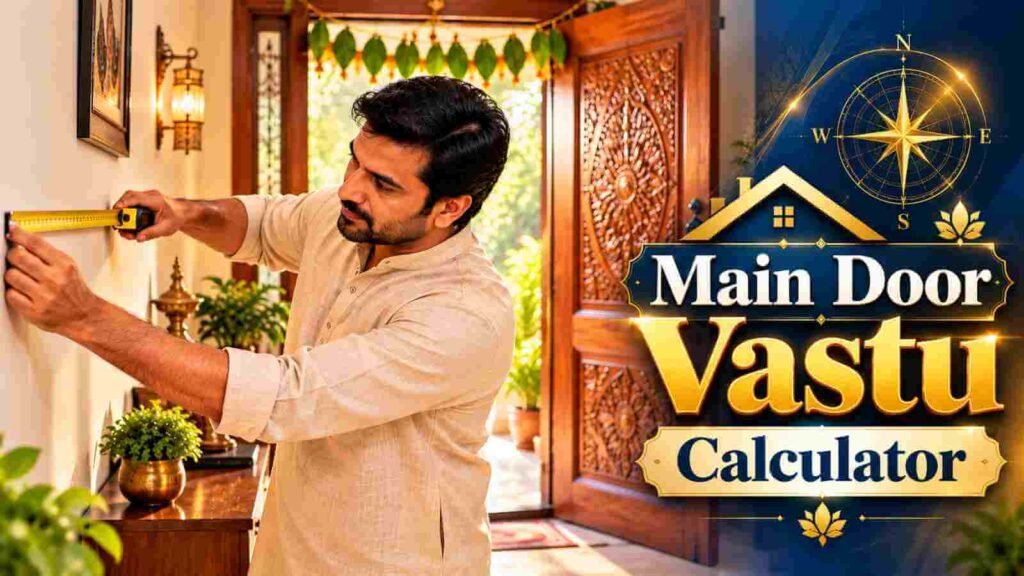
How to measure: stand inside your home at the main door, facing out. Measure the whole wall on that side from corner to corner, then measure from the corner on your left to the middle of the door. Use any unit — feet or metres — as long as both use the same one.
Please select a zone, or fill in the wall and both measurements.
- The short answer: Best door segments — N3, N4, N5 on the north; E3, E4 on the east; S4 on the south; W3, W4 on the west. Worst four — E1, S5, S8 and W1.
- South is not unlucky in itself, and east is not auspicious everywhere. The segment decides.
Why the Main Door Matters in Vastu
The main door is where the outside world meets your private space, and the tradition holds that the quality of that threshold shapes the flow of energy through the entire house. It is why Vastu places so much weight not only on the door’s position but on keeping it clean, bright, unobstructed and in good repair. A well-placed, cared-for entrance is read as an invitation; a neglected or badly placed one as a restriction.
The Door Segment Matters More Than the Zone
For rooms, the sixteen-zone system is precise enough. For a door, it is not — and this is the single most useful thing to understand about entrance Vastu.
Each side of a building is divided into eight door segments called padas, giving thirty-two around the whole perimeter. Each of the sixteen zones spans exactly two of them. When both of a zone’s padas agree, the zone’s verdict is reliable. When they disagree, the zone verdict is an average of two opposite readings, and it can badly mislead you. We checked every zone against its two padas:
| Zone | Usual reputation | The two padas inside it |
|---|---|---|
| East | Highly auspicious | E4 Indra — auspicious · E5 Surya — not |
| South | Feared | S4 Gruhakshat — the best south entrance · S5 Yama — one of the four worst in the system |
| North-East | Sacred | N8 Diti — favourable · E1 Shikhi — one of the four worst |
| East-North-East | Favourable | E2 Parjanya — not · E3 Jayanta — auspicious |
| South-South-East | Workable | S2 Pusha — not · S3 Vitatha — auspicious |
| West-South-West | Weak | W2 Dauvarik — not · W3 Sugreev — auspicious |
| North-North-West | Weak | N2 Naga — not · N3 Mukhya — one of the best |
| North-North-East | Favourable | N6 Bhujag — not · N7 Aditi — not |
Seven of the sixteen zones are mixed — one good pada, one bad. And the north-north-east, usually described as favourable, contains two inauspicious padas and no good one at all.
Two rows stand out. The east, which almost every guide calls one of the two best directions for a door, is only auspicious in its northern half. And the south — the direction people fear — contains both the best south entrance and one of the four worst entrances anywhere in the system, side by side in the same zone.
Five feet apart
To make this concrete: take a house with a south wall forty feet long. Stand inside at the door facing out and measure from the left-hand corner. A door centred seventeen feet along falls in S4 Gruhakshat — the strongest entrance on the south side, associated with prosperity and recognition. A door centred twenty-two feet along falls in S5 Yama — one of the four worst entrances in the whole thirty-two, associated with debt and loss.
Same wall, same direction, same zone. Five feet. That is why the calculator now asks for measurements, and why a Vastu verdict that stops at “south-facing” or “east-facing” tells you surprisingly little about your actual door.

How to Find Your Exact Door Segment
You need a measuring tape and two minutes.
- Stand inside your home at the main door, facing out. This orientation matters: it makes the numbering work the same way on all four walls.
- Measure the full length of that wall — the whole side of the building, from corner to corner, not just the room.
- Measure from the corner on your left to the centre of the door.
- Enter both numbers in the calculator. Any unit works, as long as both measurements use the same one.
Behind the scenes, the wall is divided into eight equal parts, numbered 1 to 8 from your left. Pada 1 is always the part nearest your left-hand corner. So on a north wall, standing inside facing out, N1 is at the west end and N8 at the east end; on a south wall, S1 is at the east end and S8 at the west end.
For a flat, use your own flat’s outer wall on the entrance side. A door that falls exactly on the line between two padas is a borderline case; practitioners generally read the pada holding most of the door’s width.
All 32 Door Segments
The meanings below are the widely shared traditional readings. Across sources they agree closely: eleven auspicious padas, seventeen inauspicious, and four singled out as the worst.
North wall — N1 at the west end, N8 at the east end
| Pada | Name | Verdict | Traditional reading |
|---|---|---|---|
| N1 | Roga | Inauspicious | Illness and friction |
| N2 | Naga | Inauspicious | Envy and rivalry |
| N3 | Mukhya | Auspicious | Among the best of all: prosperity and family blessings |
| N4 | Bhallat | Auspicious | Abundance and steady financial growth |
| N5 | Soma | Auspicious | Wealth with a calm household |
| N6 | Bhujag | Inauspicious | Quarrels, especially with children |
| N7 | Aditi | Inauspicious | Friction within the family |
| N8 | Diti | Favourable | Generally favourable, less consistently rated |
East wall — E1 at the north end, E8 at the south end
| Pada | Name | Verdict | Traditional reading |
|---|---|---|---|
| E1 | Shikhi | One of the four worst | Fire, accidents and loss |
| E2 | Parjanya | Inauspicious | Wasteful spending |
| E3 | Jayanta | Auspicious | Success and a widening circle |
| E4 | Indra | Auspicious | Influence and support from authority |
| E5 | Surya | Inauspicious | Anger and rash decisions |
| E6 | Satya | Inauspicious | Unreliability and broken commitments |
| E7 | Bhrisha | Inauspicious | Conflict and strained relationships |
| E8 | Antariksha | Inauspicious | Theft and loss |
South wall — S1 at the east end, S8 at the west end
| Pada | Name | Verdict | Traditional reading |
|---|---|---|---|
| S1 | Anil | Inauspicious | Strain between parents and children |
| S2 | Pusha | Inauspicious | Dependence and family conflict |
| S3 | Vitatha | Auspicious, with a caveat | Prosperity — with a traditional warning about cutting corners |
| S4 | Gruhakshat | Best south entrance | Prosperity and recognition |
| S5 | Yama | One of the four worst | Debt and loss |
| S6 | Gandharva | Inauspicious | Financial struggle and loss of standing |
| S7 | Bhringraj | Inauspicious | Effort that does not pay off |
| S8 | Mriga | One of the four worst | Sorrow and loss of wealth |
West wall — W1 at the south end, W8 at the north end
| Pada | Name | Verdict | Traditional reading |
|---|---|---|---|
| W1 | Pitra | One of the four worst | Ancestral burdens and loss |
| W2 | Dauvarik | Inauspicious | Dissatisfaction and restlessness |
| W3 | Sugreev | Auspicious | Prosperity and steady gains |
| W4 | Pushpadanta | Auspicious | Growth, especially for the next generation |
| W5 | Varun | Favourable | Gains and stability, rated favourable by fewer sources |
| W6 | Asura | Inauspicious | Trouble involving authorities |
| W7 | Sosha | Inauspicious | Loss and sorrow |
| W8 | Papyakshama | Inauspicious | Deception and misdeeds |
Notice where the four worst sit: E1, S8, W1 and — nearly opposite — S5. Three of them cluster at corners. That is one reason for the long-standing rule that a main door should never sit on the exact corner of a building.
A note on S3 Vitatha
You will find S3 described simply as “fame and authority” in some places. The fuller traditional reading is more interesting: it brings prosperity and success, but the tradition warns that households with this entrance can be tempted to cut corners to get there. It is auspicious, with a character caveat. If you have the choice on a south wall, S4 Gruhakshat is the cleaner option.
A note on the older texts
Some traditional pada descriptions carry social assumptions of their time — reading the birth of daughters as a misfortune, for example. We have left those out. The directional framework is the part worth keeping; those judgements are not.
Is a South-Facing Main Door Really Bad?
No — and the thirty-two padas show exactly why the fear is misplaced. The south side has one of the four worst entrances in the system (S5 Yama) and one of the strongest (S4 Gruhakshat), a few feet apart. Condemning the whole direction throws away the good entrance along with the bad one. Placed in S3 or S4, a south entrance is a sound choice.
The reverse holds too, and matters just as much. A north-facing house is not automatically well placed. A north door in N1 or N2 falls on inauspicious padas, and is worse by this reckoning than a south door in S4. As one experienced practitioner puts it, the facing of the entrance matters less than its exact location.
This is worth knowing when buying. South-facing properties often sell for less because so many buyers avoid them. With the door correctly placed, that discount is an opportunity.
Main Door Rules: Do’s and Don’ts
Size, opening and lighting
The main door should be the largest and most impressive door in the home, so it clearly reads as the main entrance. It should open inward and clockwise, move smoothly without creaking, and be well lit. Bright light at the entrance is one of the simplest ways to strengthen it.
Threshold, nameplate and symbols
A raised threshold (dehli) is traditionally believed to hold good energy in and keep negativity out. A clean nameplate and auspicious symbols — a toran, Om, swastika or Ganesha — are considered welcoming, as is a small healthy plant beside the door.
What to avoid
Avoid a cracked, broken or creaking door, and never let a shoe rack, dustbin or clutter block the doorway. The door should not line up directly with a toilet, a staircase or the back door, and should not sit on the exact corner of the building. Even a perfectly placed entrance loses much of its benefit if the energy immediately hits a blank wall or a staircase inside.
Colours, Materials and Décor
Wood is the most recommended material for a main door; heavy metal is considered less ideal for the primary entrance. Colour traditionally follows direction: greens, browns or cream for an east door; white, cream or light metallic tones for north and west; warm reds, oranges or browns for south. Black is best avoided. A nameplate, a toran of fresh leaves, a small rangoli and good lighting complete a welcoming entrance.
The Space in Front of the Door
What lies directly in front of the door matters too. A large tree, electric pole, lamp post or wall directly facing the entrance is called dwaar vedha — an obstruction — and is traditionally avoided. So is a road pointing straight at the door (Veedhi Shoola), though far less so when it comes from the north or east than from the south or west. Where an obstruction cannot be removed, keep the entrance bright, add a plant to one side, and use auspicious symbols.
Main Door Vastu for Flats and Apartments
In a flat, your own flat’s door is the primary entrance; the building’s main gate matters less, especially if you do not own the building. The precise check works the same way — measure your flat’s outer wall on the entrance side. You cannot move the door, so focus on what you control: keep it clean and bright, add a nameplate and threshold, keep the doorway clear of shoe racks, and make sure it opens fully. If it faces a lift, a descending staircase or another door directly, a threshold, a plant or an auspicious symbol helps.
Remedies for a Door in an Inauspicious Segment
Rebuilding a door is rarely practical, so the traditional remedies focus on the entrance itself: keep it spotless and brightly lit, add a threshold if there is none, and place auspicious symbols at the door. Balancing the rest of the home — the north-east light and open, the south-west heavy and solid — helps too.
Be honest with yourself about limits, though. Experienced practitioners note that surface remedies do not fully correct a structural defect, particularly a south-west entrance, and they are sceptical of generic fixes like mirrors and wind chimes for this purpose. If you are building or renovating, moving the door a few feet into a good pada is the one remedy that genuinely solves the problem — and as the five-feet example shows, it often takes very little. Be wary of anyone selling expensive devices or strips to “neutralise” a door.
Common Misconceptions
- “East-facing is always auspicious.” Only the northern half of the east zone. The southern half (E5 Surya) is inauspicious.
- “South-facing is always bad.” The south holds S4 Gruhakshat, one of the strongest entrances. It also holds S5 Yama. The segment decides.
- “North-facing is automatically good.” N1 and N2 are inauspicious. A north door there is worse than a south door in S4.
- “The north-east corner is ideal for a door.” The exact corner falls in E1 Shikhi, one of the four worst segments. Keep doors off corners.
- “The direction the door faces is what counts.” For Vastu, the door’s position along the wall counts for more.
- “A mirror or wind chime fixes a bad entrance.” Surface remedies soften; they do not relocate a door.
- “It is scientifically proven.” Vastu is a traditional belief system, offered here as a framework for placing an entrance with care.
Frequently Asked Questions
Which direction is best for a main door?
North, east, north-east and west are generally favourable — but within each, the exact segment matters more. The best segments are N3, N4, N5, E3, E4, S4, W3 and W4.
What are the 32 entrances in Vastu?
Each side of a building is divided into eight door segments, or padas, giving thirty-two in all. Eleven are auspicious, seventeen inauspicious, and four — E1, S5, S8 and W1 — are singled out as the worst.
How do I find which pada my door is in?
Stand inside at the door facing out. Measure the full wall, then measure from your left-hand corner to the centre of the door. The calculator divides the wall into eight and gives your pada.
Is a south-facing main door bad?
No. S4 Gruhakshat is one of the strongest entrances in the system, and S3 Vitatha is also auspicious. Only certain south segments — especially S5 Yama — are to be avoided.
Is an east-facing door always good?
No. The northern half of the east zone holds E4 Indra, which is auspicious; the southern half holds E5 Surya, which is not. E1, at the north-east corner, is one of the four worst.
Why is the zone result different from the segment result?
Because each zone spans two padas, and in seven of the sixteen zones those two padas disagree. For a door, trust the segment result.
Should the main door open inward or outward?
Inward and clockwise, moving smoothly without obstruction.
What should I place at the main entrance?
A raised threshold, a clean nameplate, auspicious symbols such as a toran or Om, good lighting and a healthy plant. Keep the doorway clear.
What colour should the main door be?
Traditionally green or brown for east, white or light tones for north and west, warm red or brown for south. Wood is preferred and black is best avoided.
Does the main door Vastu calculator really work?
It applies the traditional thirty-two pada system precisely and consistently, and its zone verdicts are checked against our verified reference. The guidance itself is traditional belief rather than proven science.
Related Vastu Tools and Guide
For every room in one place, read our Vastu Directions Guide. You can also continue with:
- Plot Vastu Calculator — check the land before placing the door.
- Vastu Direction Calculator — confirm which way your home faces.
- Office Vastu Calculator — entrances and reception for a workplace.
- Vastu Score Calculator — check the whole home.
The direction your door faces is the starting point, not the verdict. Measure the wall, find your segment, and keep the entrance bright and clear — and if you are building, remember that a few feet can separate the best entrance from one of the worst.
This information is based on traditional Vastu Shastra principles and is intended for general guidance and self-reflection, not as a substitute for professional architectural or Vastu consultation. Read our full Disclaimer for more.