

Vastu Directions Guide: Vastu Shastra is India’s traditional system of architecture. It asks where each part of a building should sit, the kitchen, the bedroom, the main door, the toilet, the pooja room, and it reads those placements through directions and the five elements. This guide brings the recommended direction for every important part of a home and workplace into one place, on the same 16-zone map that our free Vastu calculators use, with a link in each section to the tool that checks that part of your own home.
Two things make this guide different from most. First, it is honest about the status of Vastu: it is a traditional belief system, not a proven science, and some of its rules are simply good sense about light, air and layout while others are matters of faith. Second, Vastu schools do not agree on everything.
The classical texts, the modern 16-zone MahaVastu method and popular guides give different answers on toilets, entrance positions and Aaya formulas, and we say so wherever it matters, along with which rule our calculators follow. The aim of Vastu, done well, is a calm, bright and practical home, never a home that makes you anxious.
Use the table of contents to jump straight to the part you need.
1. Vastu Basics: The 16 Directions and Five Elements
Every rule in this guide rests on two ideas: directions, and the five elements that are said to belong to them. Once these make sense, the room-by-room advice stops feeling like a list to memorise.
What Is Vastu Shastra?
Vastu Shastra means, roughly, the science of dwelling or building. It comes from a body of Sanskrit texts on design, layout, measurement and construction. Six are the most studied: the Mayamata, the Manasara, the Samarangana Sutradhara, the Rajavallabha, the Vishvakarmaprakasha and the Aparajitaprccha; the Mayamata and Manasara, both of South Indian origin, are thought to have been in circulation by about the fifth to seventh century.
At the heart of these texts is the Vastu Purusha Mandala, a square grid laid over a site, most often of 64 or 81 squares, with a cosmic figure imagined lying across it. In the 81-square version his head lies in the north-east and his feet in the south-west, which is why the north-east is treated as the most sacred corner.
How to regard Vastu today is a genuine debate. Many modern architects treat the texts as flexible guidelines about sunlight, ventilation, flow and function rather than rigid codes. Rationalist critics call much of today’s Vastu consultancy pseudoscience; the astronomer Jayant Narlikar, for one, has argued that rules such as parallelogram-shaped plots causing family quarrels have no logical connection to the environment. This guide takes a middle path: it explains the traditional rules clearly, notes where they overlap with plain good design, and never presents them as guarantees.
Two Maps: Classical Directions and the 16 Zones
The classical texts work with eight directions, each with a guardian deity: Kubera in the north, Indra in the east, Yama in the south, Varuna in the west, Ishana in the north-east, Agni in the south-east, Nirriti in the south-west and Vayu in the north-west. Many modern consultants use a finer map of sixteen zones of 22.5 degrees each.
The best-known version is MahaVastu, a modern method developed by the Vastu consultant Khushdeep Bansal, who began practising in the 1990s; by its own account it adapts the classical zones to contemporary buildings. The calculators on this site use this 16-zone map, so this guide does too, while pointing out where the classical view differs.
The Five Elements (Panchtattva)
Vastu, like Ayurveda and Yoga, draws on the five great elements of Indian philosophy. In the classical corner scheme each element has a home direction:
- Water (Jal): the north-east, linked with clarity, growth and wealth.
- Fire (Agni): the south-east, linked with energy, cooking and cash flow.
- Earth (Prithvi): the south-west, linked with stability and relationships.
- Air (Vayu): the north-west, linked with movement and support.
- Space (Akash): the centre, the Brahmasthan, which should stay open.
Most traditional “faults” are clashes of elements, such as a kitchen’s fire in the north-east’s water zone, and most traditional remedies try to restore the balance. In the 16-zone system, each zone is given an element. Sources agree on the core, water in the north and north-east, fire in the south-east and south, earth in the south-west, air in the north-west, but they differ on the zones in between, as the table below shows.
The 16 Zones Explained
Here are the sixteen zones, the compass bearings they cover, the element most often given for each, and the life area each governs in MahaVastu. Where sources disagree on an element, both are shown.
| Zone | Compass bearing | Element (commonly given) | Governs |
|---|---|---|---|
| N, North | 348.75° to 11.25° | Water | Money, career, new opportunities |
| NNE, North of North-East | 11.25° to 33.75° | Water | Health and immunity |
| NE, North-East (Ishanya) | 33.75° to 56.25° | Water | Mind, clarity, wisdom |
| ENE, East of North-East | 56.25° to 78.75° | Water or Air | Fun, recreation, refreshment |
| E, East | 78.75° to 101.25° | Air | Social connections |
| ESE, East of South-East | 101.25° to 123.75° | Air | Churning, analysis, anxiety |
| SE, South-East (Agneya) | 123.75° to 146.25° | Fire | Cash flow, liquidity |
| SSE, South of South-East | 146.25° to 168.75° | Fire | Strength, confidence |
| S, South | 168.75° to 191.25° | Fire | Fame, recognition, relaxation |
| SSW, South of South-West | 191.25° to 213.75° | Earth | Disposal of waste, expenditure |
| SW, South-West (Nairutya) | 213.75° to 236.25° | Earth | Relationships, skills, stability |
| WSW, West of South-West | 236.25° to 258.75° | Earth or Space | Education, study, savings |
| W, West | 258.75° to 281.25° | Space (some sources: Water or Earth) | Gains, profits |
| WNW, West of North-West | 281.25° to 303.75° | Space or Air | Detox, letting go of stress |
| NW, North-West (Vayavya) | 303.75° to 326.25° | Air | Support, banking, helpful people |
| NNW, North of North-West | 326.25° to 348.75° | Air or Water | Attraction, pleasure |
Notice that each zone is centred on its direction: north covers 11.25 degrees either side of 0 degrees. Some websites instead start the north zone at 0 degrees and run it to 22.5 degrees. That shifts every boundary by 11.25 degrees, half a zone, and can move a room into the next zone. The centred convention above is the usual one in the 16-zone sources our calculators follow.
How to Find Directions in Your Home
- Use a real compass or a calibrated phone compass. Calibrate the phone first, hold it flat, and stand away from steel almirahs, refrigerators, inverters and wiring, which can pull the needle.
- Take readings from the centre. Stand near the centre of the home, note north, and mark the directions on a simple sketch of your floor plan. Take two or three readings in different spots and compare.
- Do not worry about true north versus magnetic north in India. The gap, called magnetic declination, is tiny here. India’s Class 12 physics textbook gives it as about 0°41′ east at Delhi and 0°58′ west at Mumbai, and elsewhere in the country it is within about two degrees. A zone is 22.5 degrees wide, so this almost never changes a zone.
- Be careful near boundaries. If a room or a door sits within a few degrees of a zone line, measure again, because a small error can flip the reading.
Find your zones and facing with the Vastu Direction Calculator
2. House Facing Direction
The facing of a home is usually the first thing a Vastu reading looks at, because it describes the side from which the home meets the world.
- Best: East, North, North-East.
- Favourable: West.
- Workable with the right layout: South, South-East, North-West.
- Needs the most care: South-West.
What Is the Facing Direction?
Your home’s facing is the direction you look towards when you stand at the main door and step outside. If you look east as you leave, it is an east-facing home. In a flat, most consultants read the flat’s own main door, not the building’s gate. If the door looks towards a corner, note the corner, such as north-east, rather than forcing it into the nearest cardinal direction.
How to Find Your Home’s Facing Direction
Stand just inside the main door and face outwards, as if you are about to leave. Hold the compass flat and read the direction. That is your facing. Remember it is the opposite of the direction you walk when you come in.
Two Mistakes to Avoid When Reading the Facing
First, take the reading while stepping out, not while walking in. The two readings are exact opposites, and in our own count, reading it the wrong way round changes the verdict for half of all possible directions, turning a north-east home into a south-west one on paper. Second, be careful with readings close to a zone boundary: about one reading in five lies within 2 degrees of one, where a small error can move it into the next zone. Our Vastu Direction Calculator accepts the degrees straight from your phone compass, names the opposite zone as a check, and warns you when a reading sits near a boundary.
The Auspicious and Workable Facings
East-facing homes greet the morning sun and are traditionally linked with health and growth. North-facing homes are linked with Kubera and with money and opportunities. North-east facing is considered the most spiritual of all, provided that corner stays clean and light. West-facing homes, the direction of Varuna, are traditionally described as bringing steady gains. South-east, north-west and south facings are workable when the internal layout is right. South-west facing is the one that needs the most attention, because it is the heaviest, most grounding direction.
Is a South-Facing House Really Bad?
No. This is one of the most exaggerated fears in Vastu, and even Hindi newspaper Vastu columns now say that a south entrance is not automatically inauspicious. In the 32-entrance system described in section 6, two of the recommended door positions, S3 and S4, sit on the south side. What matters more than the facing is where exactly the door falls along the wall and how the rooms inside are arranged.
Check your facing with the Vastu Direction Calculator

3. Whole-Home Vastu Score
Rather than judging a home by one rule, a Vastu score looks at the key placements together and shows how many of them follow the traditional guidance.
The Key Placements That Shape Your Home
Ten placements carry most of the weight in home Vastu. These are the ideal directions our score calculator checks:
| Placement | Ideal direction |
|---|---|
| Main entrance | North, East, North-East, or West |
| Kitchen | South-East |
| Master bedroom | South-West |
| Pooja room | North-East |
| Toilet or bathroom | West-North-West or South-South-West |
| Underground water | North-East, North, or East |
| Overhead tank or heavy storage | South-West or West |
| Living room | North, East, or North-East |
| Staircase | South, West, or South-West |
| Centre (Brahmasthan) | Kept open and clutter-free |
How to Read Your Score
The calculator gives each placement points according to how closely it matches, adds them into a score out of 100 and shows a rating band. Read it as a checklist summary: it tells you which placements already follow the tradition and which are worth a look. It does not measure luck, and a lower score is not a warning. In most homes, especially flats, the placements you can change easily are the movable ones: the bed, the stove, the desk, the locker, the mandir and clutter in the centre.
Get your whole-home score with the Vastu Score Calculator

4. Kitchen Vastu
The kitchen belongs to the fire element, Agni, and it is one of the most discussed rooms in Vastu, because cooking happens every day.
- Ideal: South-East (Agneya).
- Good: North-West, South.
- Avoid: North-East, North, South-West.
Best Direction for the Kitchen
The first choice is the south-east, the natural home of fire. The north-west is the classic second choice, because air is said to support fire, and the south is also acceptable. MahaVastu literature additionally lists the south of south-east and the west as permissible zones. The north-east is the placement every school warns against, since it puts fire in the sacred water corner; the north and south-west are also best avoided. Sources do vary at the edges, and one Hindi answer on a popular question-and-answer site even suggests the west for a kitchen, so treat the south-east as the target and the rest as a range of acceptable compromises.
Gas Stove and Cooking Direction
Within the kitchen, the stove belongs in the south-east corner, ideally on the east or south-east platform. The cook should face east while cooking, which also happens to put morning light in front of the person at the stove. Facing north is the next best. Facing south while cooking is traditionally discouraged, and turning the stove so the cook faces east is often the simplest correction in a flat.
Sink, Fridge and Storage
Water and fire are treated as opposites, so the sink goes towards the north or north-east of the kitchen, away from the stove. The refrigerator suits the south-east, south or west; grains and heavy storage the south or west walls; and drinking water the north-east. Keeping the sink and stove apart is also plain good kitchen design: it avoids splashes near the flame.
Kitchen Colours
Warm shades that echo fire, such as yellow, orange and soft red, are traditionally recommended, along with light green and earthy tones. Large areas of black or dark blue are usually avoided around the cooking area because they represent water.
Remedies for a Wrong Kitchen Direction
You do not need to rebuild. Move the stove to the south-east of the kitchen, cook facing east, keep water and fire apart, and keep the kitchen spotless and well ventilated with a working exhaust. These steps cover most of what the tradition asks for, and they make a better kitchen whatever you believe.
Check your kitchen with the Kitchen Vastu Calculator
5. Bedroom Vastu
A bedroom is for rest and for the relationship of the people who share it, so both its direction and the direction you sleep in are discussed.
- Master bedroom ideal: South-West.
- Sleep: head to the South or East.
- Avoid the master bedroom in: North-East, South-East.
Master Bedroom Direction
The south-west, the heaviest and most grounding zone, is the traditional place for the master bedroom, linked with stability and the bond between the couple who head the family. The south and west, and the south of south-west and west of south-west zones, also work. The north-east is avoided for the master bedroom because the sacred, light corner is not considered settling for the heads of the household, and the south-east, the fire zone, is traditionally linked with restlessness and arguments.
Sleeping Direction (Head Position)
Sleep with your head towards the south, the traditional first choice, or the east, often recommended for students. The west is acceptable. Sleeping with the head towards the north is the one position the tradition says to avoid. You will often read that this is because of the Earth’s magnetic field; that explanation is a traditional belief rather than an established scientific finding, so treat the rule as part of the tradition, and if your room only allows a north-head position, a good mattress and a quiet, dark room will matter far more to your sleep.
Children’s, Guest and Study Rooms
Children’s bedrooms suit the west, north-west or east. The west of south-west, the zone of study in the 16-zone map, is traditionally good for a student’s desk, as are the east and north. Guest rooms suit the north-west, the zone of movement, which is also traditionally suggested for a daughter of marriageable age. These are traditional preferences; practical needs such as quiet, light and a desk near a window count for just as much.
Bed, Mirror and Other Tips
Keep the heaviest furniture, usually the bed and wardrobe, in the south-west part of the bedroom. Avoid a mirror that reflects the bed, or cover it at night. Avoid sleeping under a beam, and keep the room calm and clutter-free, without a fountain or aquarium. A television is best avoided or covered when not in use.
Bedroom Remedies
If a couple’s bedroom sits in the south-east, the tradition’s strongest suggestion is to move it to the south-west. Where that is not possible, turn the bed so the head points south or east, declutter, use calm earthy colours and keep the south-west of the room solid and heavy. None of this needs construction.
Check your bedroom with the Bedroom Vastu Calculator

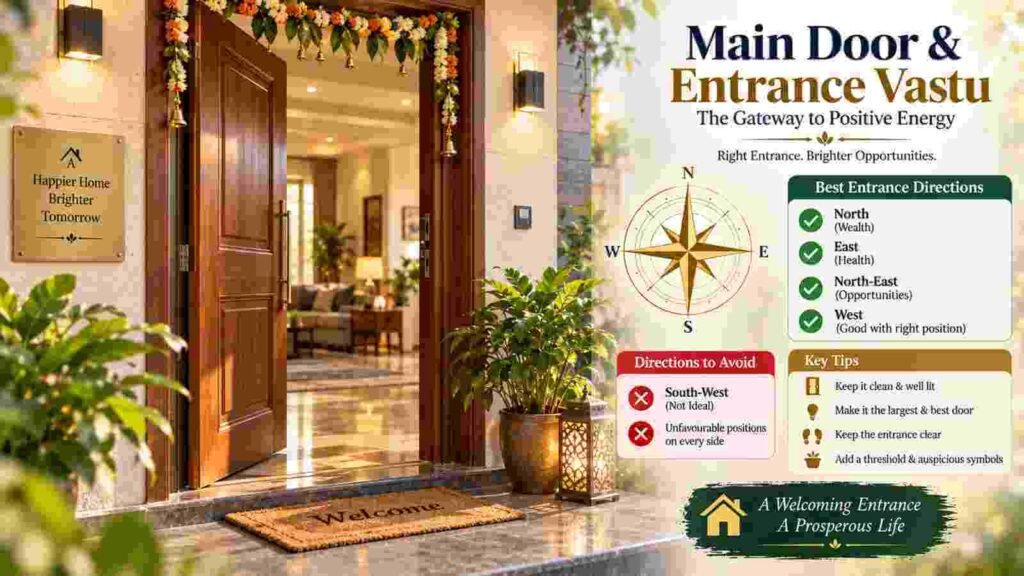
6. Main Door and Entrance Vastu
The main door is called the mouth of the home, the point where people, light and, in the tradition, energy and opportunity come in. Its exact position gets more attention than almost anything else in Vastu.
Best: North, East, North-East and the right positions on the West. Avoid: South-West and the unfavourable positions on every side.
Best Entrance Directions
The most widely recommended entrances are in the north, east and north-east, followed by favourable positions on the west. These directions receive good light and are traditionally linked with wealth, health and opportunity. Within any direction, the exact position of the door matters as much as the direction itself, which is what the 32-entrance system describes.
The 32 Entrance Positions (Padas)
In the 32-entrance system used by the 16-zone schools, the full circle around a home is divided into 32 positions of 11.25 degrees each, eight on each side, numbered clockwise from the corner: E1 to E8 run from the north-east corner to the south-east corner, S1 to S8 from south-east to south-west, W1 to W8 from south-west to north-west, and N1 to N8 from north-west back to north-east. Each position is named after a deity of the Vastu mandala. To find yours, stand at the centre of the home and take the compass bearing to the middle of the main door.
One widely used 16-zone list, the one our Vastu calculators draw on, recommends ten of the 32 positions:
| Position | Name | Bearing from the centre | Zone |
|---|---|---|---|
| N3 | Mukhya | 337.5° to 348.75° | NNW |
| N4 | Bhallat | 348.75° to 360° | N |
| N5 | Soma | 0° to 11.25° | N |
| E3 | Jayanta | 67.5° to 78.75° | ENE |
| E4 | Indra | 78.75° to 90° | E |
| S3 | Vitatha | 157.5° to 168.75° | SSE |
| S4 | Grihakshat | 168.75° to 180° | S |
| W3 | Sugreev | 247.5° to 258.75° | WSW |
| W4 | Pushpadanta | 258.75° to 270° | W |
| W5 | Varun | 270° to 281.25° | W |
Two things stand out when you lay the list on a compass. First, the ten recommended positions cover 112.5 degrees, just under a third of the circle, so most homes do not have a textbook door and there is no need to panic about it. Second, all ten lie along the four sides rather than at the corners. The two positions right at the north-east corner, E1 (Shikhi) and N8 (Diti), are not on this list, even though a north-east facing is widely praised: E1 is generally described as unfavourable, and N8 appears on some lists and not others.
If your door sits near the north-east corner, its exact position is worth checking. The schools also disagree on several other positions: one popular guide calls N5 inauspicious, another calls N4 unfavourable where most call it excellent, and S3 is listed as good by some and to be avoided by others.
Main Door Do’s and Don’ts
- Do make the main door the largest and best-finished door in the home, opening inwards and clockwise.
- Do keep it well lit, clean and welcoming, with a threshold (dehli), a nameplate and, if you like, a toran or an auspicious symbol.
- Don’t let a pole, tree, pile of shoes or clutter block the door, and avoid a toilet door directly facing it.
- Don’t leave a door cracked, jammed or creaking; repairs are the simplest entrance remedy of all.
Entrance Remedies
If your door sits in a less favourable position, the traditional remedies are simple: keep the entrance spotless and bright, add a threshold and auspicious symbols, and keep the path clear. Some consultants also use metal strips or colours at the threshold. A well-lit, uncluttered entrance is safer and more welcoming in any case.
Check your entrance with the Main Door Vastu Calculator
7. Toilet and Bathroom Vastu
A toilet is the place of disposal, so Vastu tries to put it where letting go is helpful and to keep it away from sacred or stabilising zones. This is also the room where schools disagree most.
- Best (the rule our calculator follows): West-North-West, South-South-West, East-South-East.
- Workable with care: South, North-North-West, West.
- Avoid: North-East, South-West, the centre, and preferably North, East and North-North-East.
Best Toilet Directions
In the 16-zone map, the west of north-west is the zone of detox and letting go of stress, the south of south-west is the zone of disposal, and the east of south-east is the zone of churning. These three are the classic toilet zones in MahaVastu-based guidance, and they are the ones our calculator rates highest.
Where Sources Disagree
| Source | Best toilet location |
|---|---|
| MahaVastu literature | South of south-west (ideal), then east of south-east and west of north-west |
| A leading 16-zone Vastu consultancy | West of north-west (best), then south of south-west and east of south-east |
| A major Indian sanitaryware brand’s guide | North-west (most preferred), then south-east |
| Several popular home and property guides | North-west or west |
| One popular astrology site | South or south-west |
Two disagreements matter. The north-west, the favourite of many mainstream guides, is the zone of support in MahaVastu, which warns that a toilet there leaves people feeling unsupported. And the south-west, which one site calls best, is the zone that most other sources say to avoid for a toilet above all except the north-east. The one point on which everyone agrees is the north-east, and the centre of the home, should not hold a toilet.
Toilet Seat Facing Direction
The usual rule is that the person using the toilet should face north or south, not east or west, which means aligning the commode along the north-south axis. One leading consultancy adds that for householders, facing west is also acceptable.
Washbasin, Geyser, Drainage and Door
Put the washbasin and mirror on the north or east wall, the geyser and electrical fittings in the south-east, and slope the floor so water drains towards the north or east. The bathroom door is best on the north or east. Keep the toilet lid down and the door closed, and never share a wall with, or sit directly above or below, the pooja room or kitchen.
Toilet Remedies
A clean, dry, well-ventilated toilet with a working exhaust fan is the most important remedy in any tradition, and simply good hygiene. Keep the door shut, fix leaks at once and use light colours. A bowl of sea salt, changed regularly, is a popular traditional remedy, particularly for a north-east toilet.
Check your toilet placement with the Toilet Vastu Calculator

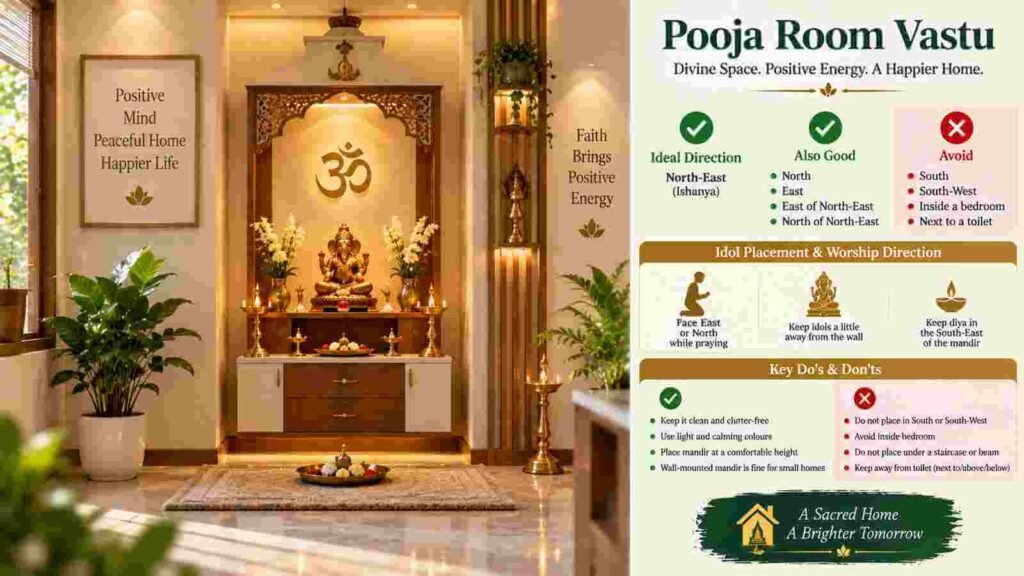
8. Pooja Room Vastu
The pooja room, or home mandir, is the spiritual centre of many Indian homes, and Vastu gives it the most sacred corner.
- Ideal: North-East (Ishanya).
- Good: North, East, East of North-East, North of North-East.
- Avoid: South, South-West, inside a bedroom, next to a toilet.
Best Direction for the Pooja Room
The north-east, Ishanya, is the ideal place for a mandir; it is linked with clarity, wisdom and meditation in every school. The north and east are also good, as are the neighbouring zones east of north-east and north of north-east. If none of these is available, some Vastu columnists suggest the west as a fallback, but most sources would first choose a north-east or east wall of the living room.
Idol Placement and Worship Direction
Face east or north while praying. Keep the idols a little away from the wall, not facing each other, and not facing straight out of the main door. Place the main idols at a comfortable height rather than on the floor, and keep the lamp or diya in the south-east of the mandir.
Pooja Room Do’s and Don’ts
Do not place the mandir in the south or south-west, inside a bedroom, under a staircase, under a beam, or next to, above or below a toilet. Keep it clean and free of storage underneath. In a small flat, a wall-mounted mandir on the north-east or east wall of the living room is a sensible solution.
Check your mandir with the Pooja Room Vastu Calculator
9. Plot Vastu
The land itself sets the foundation for everything built on it, so plot Vastu is most useful before you buy or build.
- Best: square or rectangular, extended in the north-east, sloping towards the north-east.
- Avoid: a cut north-east, an extended south-west, irregular shapes.
Best Plot Shape
Square and rectangular plots are preferred, with the length up to about twice the breadth. A plot extended at the north-east corner is considered especially good. Triangular, L-shaped and very irregular plots are usually avoided because their layout is hard to balance, which is also true in practical terms: odd shapes waste space.
Cuts and Extensions
A missing north-east corner is considered harmful because it removes the most valued zone, and a missing south-west weakens stability. An extended south-west over-emphasises a heavy zone and is best avoided. As a rule, extensions in the north-east are welcome, while cuts or extensions in the south-west and south-east need care.
Plot Slope and Level
The ideal plot is higher in the south-west and slopes gently down towards the north-east, north or east, so rainwater flows that way. Any water body or borewell is preferred in the north-east. The reverse slope, high in the north-east and low in the south-west, is traditionally corrected with earthwork before building.
Roads and Corner Plots
Plots with roads on the north or east are generally favoured. Among corner plots, a north-east corner plot, open on both north and east, is considered excellent; south-west, south-east and north-west corners need a more careful layout. A plot facing a T-junction, called veedhi shoola, is avoided unless the road meets it on a favourable side.
Gaumukhi and Shermukhi Plots
A Gaumukhi plot is narrow at the front and wide at the back, like a cow’s face, and is traditionally preferred for homes. A Shermukhi plot is wide at the front and narrow at the back, like a lion’s face, and is preferred for shops and commercial buildings.
The logic behind the usual advice is about where the wide end falls: a Gaumukhi plot facing south or west has its broad end towards the north-east, and a Shermukhi plot facing north or east has its broad front there.
One honest note. Critics of Vastu single out plot-shape rules, such as the claim that a parallelogram-shaped plot causes family quarrels, as having no logical link to how people actually live. The practical reasons to prefer a regular, well-drained plot with good road access are strong in any case; the stronger claims are matters of tradition.
Check a plot with the Plot Vastu Calculator

10. Office and Workplace Vastu
The same directional ideas apply to a workplace, adapted to authority, cash flow and focus.
- Owner: South-West, facing North or East.
- Reception and entrance: North, East or North-East.
Owner and Director Seating
The most important rule in office Vastu is that the owner or chief decision-maker sits in the south-west of the office, with a solid wall behind and facing north or east. This is said to give stability and authority. Senior managers can sit in the south or west, also facing north or east.
Cash, Accounts and Locker
Here two conventions exist, and it is worth knowing both. The traditional one places the locker or safe against the south or south-west wall so that it opens towards the north, the direction of Kubera. The 16-zone view instead links cash with the north zone of money and the south-east zone of cash flow, and some consultants place the cash counter or locker there. Accounts staff are commonly placed in the south-east. Whichever you follow, the locker should open towards the north.
Reception, Staff and Meeting Rooms
Place the reception in the north-east, north or east, which are bright and welcoming. Arrange workstations so staff face north or east. The conference room suits the north-west or west, and sales and marketing staff, whose work involves movement, suit the north-west.
Pantry, Storage and Toilets
The pantry, as a fire zone, suits the south-east. Heavy storage and records belong in the south-west. Office toilets follow the home rule: west of north-west, south of south-west or east of south-east, and never the north-east. Keep the north-east of the office light and open, and the south-west heavy and closed.
Check your workplace with the Office Vastu Calculator

11. Aaya: Vastu Construction Measurement
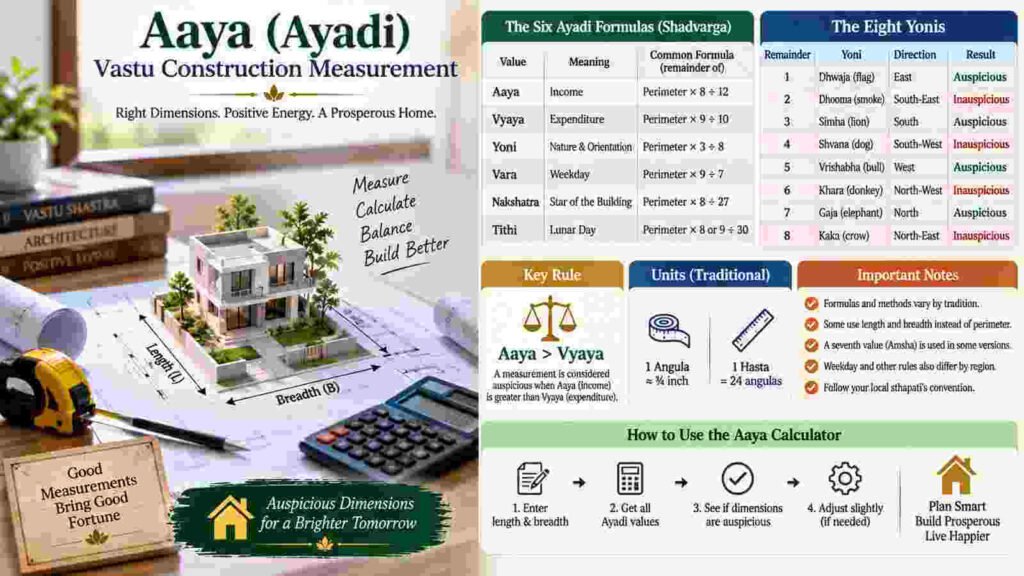
Aaya, or more fully Ayadi, is the most technical part of traditional Vastu. It checks whether the dimensions of a building or room are auspicious using simple arithmetic set down in the classical texts.
What Is Ayadi or Aaya?
Before fixing a building’s dimensions, traditional builders worked out a set of values called the Ayadi Shadvarga, the six measures. The best known are Aaya, income, and Vyaya, expenditure. A measurement is considered auspicious when the Aaya comes out greater than the Vyaya, meaning the proportions “earn” more than they “spend”. Traditional sthapatis would adjust a length or breadth slightly, often by a few inches, until the values came out favourable.
The Six Formulas (Shadvarga)
Each value is the remainder of a multiplication and division. The set most widely published today, using the perimeter as the base measure, is:
| Value | Meaning | Common formula (remainder of) |
|---|---|---|
| Aaya | Income | Perimeter × 8, divided by 12 |
| Vyaya | Expenditure | Perimeter × 9, divided by 10 |
| Yoni | Nature and orientation | Perimeter × 3, divided by 8 |
| Vara | Weekday | Perimeter × 9, divided by 7 |
| Nakshatra | Star of the building | Perimeter × 8, divided by 27 |
| Tithi | Lunar day | Perimeter × 8 or × 9, divided by 30 |
Be aware that the texts and regional traditions do not agree on the details. Some versions, including the one our Aaya Calculator uses, compute Aaya from the length and Vyaya and Yoni from the breadth instead of the perimeter; some add a seventh value, Amsha; the unit also varies, with the angula often taken as three-quarters of an inch and the hasta as 24 angulas; and sources even disagree on which weekdays are unfavourable, with one list avoiding Tuesday and Saturday and another Sunday and Tuesday. A result from any calculator can therefore differ from your local sthapati’s, and where they differ, the local convention is the one traditionally followed.
The Eight Yonis
The Yoni describes the nature of the building and gives one of eight results, each linked with a direction:
| Remainder | Yoni | Direction | Traditional reading |
|---|---|---|---|
| 1 | Dhwaja (flag) | East | Auspicious, the best of all |
| 2 | Dhumra (smoke) | South-East | Inauspicious |
| 3 | Simha (lion) | South | Auspicious |
| 4 | Shwan (dog) | South-West | Inauspicious |
| 5 | Vrishabha (bull) | West | Auspicious |
| 6 | Khara (donkey) | North-West | Inauspicious |
| 7 | Gaja (elephant) | North | Auspicious |
| 8 | Kaka (crow) | North-East | Inauspicious |
Notice the pattern: the four auspicious Yonis are the odd ones, and they all point to the four cardinal directions.
How to Use the Aaya Calculator
Our Aaya Calculator works in whole feet, taking the Aaya from the length and the Vyaya and Yoni from the breadth, and prints every step. On that formula, three simple rules decide the result: a length that divides exactly by 3 always gives the highest Aaya, 12; the Vyaya is 10 minus the last digit of the breadth; and the Yoni is odd, and so auspicious, whenever the breadth is an odd number of feet. The often-repeated advice that the length should be 1.5 times the breadth makes no difference on this formula. When a result is not fully auspicious, the calculator suggests the nearest sizes within 3 feet that are. Use it at the drawing stage, and remember that the same dimensions can give a different verdict in another unit or method.
Check your dimensions with the Aaya Calculator
12. General Vastu Tips and Remedies
Beyond individual rooms, a few general principles, and a clear view of what remedies can and cannot do, go a long way.
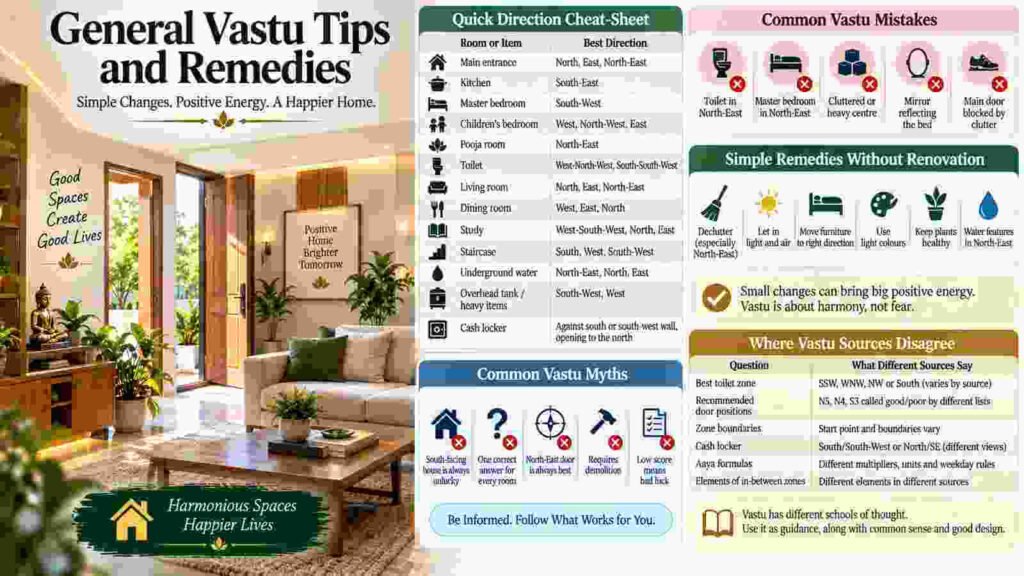
Quick Direction Cheat-Sheet
| Room or item | Best direction |
|---|---|
| Main entrance | North, East, North-East, West |
| Kitchen | South-East |
| Master bedroom | South-West |
| Children’s bedroom | West, North-West, East |
| Pooja room | North-East |
| Toilet | West-North-West, South-South-West |
| Living room | North, East, North-East |
| Dining room | West, East, North |
| Study | West-South-West, North, East |
| Staircase | South, West, South-West |
| Underground water | North-East, North, East |
| Overhead tank and heavy items | South-West, West |
| Cash locker | Against the south or south-west wall, opening to the north |
Common Vastu Mistakes
The mistakes consultants see most often in modern homes are a kitchen or toilet in the north-east, the master bedroom in the north-east, a cluttered or heavy centre, a mirror reflecting the bed, and a main door blocked by shoe racks and clutter. Fixing even one or two of these usually improves how a home feels, partly because each fix also improves light, air or order.
Simple Remedies Without Renovation
- Declutter, especially the north-east and the centre, where the tradition wants openness.
- Let in light and air from the north and east, and keep the south-west solid and heavier.
- Move what can move: the bed so your head points south or east, the stove so you cook facing east, the desk so you study facing east or north.
- Use colour gently: light shades in the north-east, earthy tones in the south-west.
- Keep water features, if any, in the north-east, and keep plants healthy and mirrors away from the bed.
What remedies cannot do is fix a leaking roof, a dark and airless room or a home you cannot afford. Be wary of anyone who sells expensive objects as the only cure, or who tells you to demolish walls on the strength of a Vastu rule alone. Where a placement genuinely cannot change, let it go: Vastu is meant to bring calm, not fear.
Where Vastu Sources Disagree
| Question | What different sources say |
|---|---|
| Best toilet zone | South of south-west (MahaVastu), west of north-west (a leading 16-zone consultancy), north-west (many mainstream guides), south or south-west (one astrology site) |
| Recommended door positions | N5, N4 and S3 are each called good by some lists and poor by others; N8 appears on some lists and not others |
| Where zone boundaries fall | Most 16-zone sources centre each zone on its direction; some start north at 0 degrees, shifting every boundary by half a zone |
| Facing of a flat | Most consultants read the flat’s own main door; one property guide says to ignore the building’s gate, while others count it as a second factor |
| Cash locker | South or south-west wall opening north (traditional) or the north or south-east zone (16-zone view) |
| Aaya formulas | Different multipliers, base measures, units and weekday rules in different texts and regions |
| Aaya proportions | Many guides say the length should be 1.5 times the breadth; on the length-and-breadth formula the ratio makes no difference |
| Elements of the in-between zones | East of north-east, west, west of north-west and north of north-west are given different elements by different sources |
Common Vastu Myths
- “A south-facing house is always unlucky.” No. Two recommended door positions sit on the south side, and layout matters more than facing.
- “There is one correct answer for every room.” Schools disagree, most of all on toilets and entrance positions.
- “A north-east door is always best.” In the 32-entrance list our calculator follows, the two corner positions at the north-east are not among the ten recommended.
- “Vastu requires demolition.” Most traditional remedies involve moving furniture, decluttering, light and colour.
- “Compass readings must be corrected to true north.” In India the difference is only about a degree or two, far smaller than a zone.
- “A low Vastu score means bad luck.” A score is a checklist summary, not a prediction.
- “Vastu is a proven science.” It is a traditional system; its practical parts overlap with good design, its other claims are matters of belief.
13. Frequently Asked Questions
Which direction is best for a house as per Vastu?
East, north and north-east facing homes are traditionally considered the most auspicious, and west-facing homes favourable. South, south-east and north-west facings work well with the right internal layout, and south-west facing needs the most care.
Which direction should the kitchen be in?
The south-east is ideal, with the north-west and south as good alternatives; MahaVastu also permits the south of south-east and the west. Every school says to avoid the north-east.
Which way should I sleep according to Vastu?
Head towards the south, or the east; the west is acceptable; avoid sleeping with your head to the north. The rule is traditional, and a comfortable, quiet, dark room matters more for sleep than direction.
Which is the correct direction for a toilet?
Our calculator follows the 16-zone rule: west of north-west, south of south-west or east of south-east. Many mainstream guides prefer the north-west or west instead. Every school agrees on avoiding the north-east and the centre of the home.
Is a south-facing house bad in Vastu?
No. With the door in a favourable position, such as S3 or S4, and a sound layout inside, a south-facing home is considered perfectly workable.
What are the 16 zones in Vastu?
They are sixteen slices of 22.5 degrees around a home, from north through north-north-east to north-north-west, each linked with an area of life. The 16-zone map is used in modern methods such as MahaVastu; the classical texts use eight directions.
How do I find the directions in my flat?
Stand near the centre, calibrate your phone compass, hold it flat away from metal and appliances, and mark north on a sketch of your floor plan. Take a few readings. For the facing itself, stand just inside your own main door and face out. In India you do not need to correct for true north.
Can I fix Vastu problems without breaking walls?
Usually, yes. Decluttering, better light and ventilation, moving the bed, stove or desk, and gentle use of colour address most traditional concerns without construction.
Is Vastu Shastra scientifically proven?
No. It is a traditional system. Many of its practical recommendations overlap with good design, but its claims about luck, wealth and health have not been shown scientifically, and rationalist critics call much of modern Vastu consultancy pseudoscience.
How accurate are online Vastu calculators?
They apply one school’s rules consistently and show you where your home stands against them, which makes them a useful starting point. They cannot see your actual home, and different schools would score some placements differently, so treat the result as guidance.
All Our Vastu Calculators
| Calculator | What it checks | Open |
|---|---|---|
| Vastu Direction Calculator | Your zones and your home’s facing | Vastu Direction Calculator |
| Vastu Score Calculator | Ten key placements, scored out of 100 | Vastu Score Calculator |
| Kitchen Vastu Calculator | Kitchen zone, stove and cooking direction | Kitchen Vastu Calculator |
| Bedroom Vastu Calculator | Bedroom zone and sleeping direction | Bedroom Vastu Calculator |
| Main Door Vastu Calculator | Entrance direction and its 32-entrance position | Main Door Vastu Calculator |
| Toilet Vastu Calculator | Toilet zone and seat direction | Toilet Vastu Calculator |
| Pooja Room Vastu Calculator | Mandir zone and worship direction | Pooja Room Vastu Calculator |
| Plot Vastu Calculator | Plot shape, slope, roads and corners | Plot Vastu Calculator |
| Office Vastu Calculator | Seating, cash, reception and workspace | Office Vastu Calculator |
| Aaya Calculator | Ayadi values for your dimensions | Aaya Calculator |
You can also browse every tool on our Vastu calculators page.
Use this guide alongside the calculators as a map, not a rulebook. Start with the easy, sensible changes, a clear centre, a bright north-east, a tidy entrance, a bed and stove turned the traditional way, and let go of what cannot change. The best Vastu is a home that feels light, open and calm to the people who live in it.
This information is based on traditional Vaidik Vastu Shastra principles and is intended for general guidance and self-reflection, not as a substitute for professional architectural or Vastu consultation. Read our full Disclaimer for more.
10 thoughts on “Vastu Directions Guide (16 Zones): The Right Direction for Every Room, Door and Plot”
Comments are closed.