
Kitchen Vastu Calculator: The kitchen is where Vastu’s fire element, Agni, lives in the home. Where the kitchen sits, where the stove goes, and which way you face while cooking are all held to shape the health and harmony of the household — which is why “which direction should my kitchen be?” is one of the most searched Vastu questions of all.
Check your kitchen’s zone on the sixteen-zone system below, and optionally your cooking direction and layout. The calculator then tells you where the stove and sink should go in your kitchen — straight, L-shaped, parallel, U-shaped or open. Further down, two things most kitchen guides skip: exactly which wall the stove belongs on, and what to do when a modular counter has put the sink right beside it.
Kitchen Vastu Calculator Online Free
Kitchen Vastu Calculator
Check your kitchen’s zone on the 16-zone system, your cooking direction, and where the stove and sink should go in your layout.
Please select the zone your kitchen is in.
The short answer:
- Kitchen — South-East is ideal, North-West the best alternative; avoid the North-East and South-West strictly
- Stove — on the east wall, at its south-east end
- Cook facing East
- Sink — towards the north-east, away from the stove.
Why Kitchen Direction Matters in Vastu
Vastu sees every home as a balance of five elements — earth, water, fire, air and space — and each direction has an affinity with one of them. The kitchen is fire. Placed in a zone that welcomes fire, it is held to keep the home balanced; placed in a zone ruled by an opposing element, especially water, it is believed to create friction that shows up as strain in health, finances or relationships.
Classical Vastu gives the south-east to Agni, the deity of fire, which is why it is called Agneya. The ancient texts placed the hearth there for reasons both sacred and practical: the strong morning and midday sun kept that corner warm and dry before modern ventilation, and a home’s natural airflow tended to carry smoke away from the living and sleeping areas. That blend of symbolism and common sense runs all through kitchen Vastu.
The Best Direction for a Kitchen
The south-east is the clear first choice. The north-west is the best alternative — it is an air zone, and air feeds fire. The south and south-south-east are acceptable, since fire sits comfortably there. The north-east is the single worst place for a kitchen, fire in the sacred water zone, and the south-west is a strict avoid too.
| Verdict | Zones | Why |
|---|---|---|
| Ideal | South-East (Agneya) | Fire’s own zone |
| Good | North-West, South, SSE | Air feeds fire; the south belt suits it |
| Acceptable with care | SSW, WNW | Workable; SSW is linked with expenses |
| Not ideal | East, ENE, ESE, West, WSW, NNW | Gentler zones that fire disturbs |
| Best avoided | North, NNE | Water zones of career and health |
| Strictly avoid | North-East, South-West | The most sacred water zone; the zone of stability |
Stove in the South-East, Face East — So Where Exactly Does the Stove Go?
Two of the most repeated rules of kitchen Vastu are usually given separately: put the stove in the south-east corner of the kitchen, and face east while cooking. Read together, they are more precise than either one alone — and following just the first can quietly break the second.
A corner has two walls. In the south-east corner of your kitchen, the stove can sit against the south wall or against the east wall. When you stand at a stove, you face the wall it is on. So:
| Stove placed on | In the south-east corner? | You face | Both rules met? |
|---|---|---|---|
| East wall, south end | Yes | East | Yes |
| South wall, east end | Yes | South | No — south is discouraged |
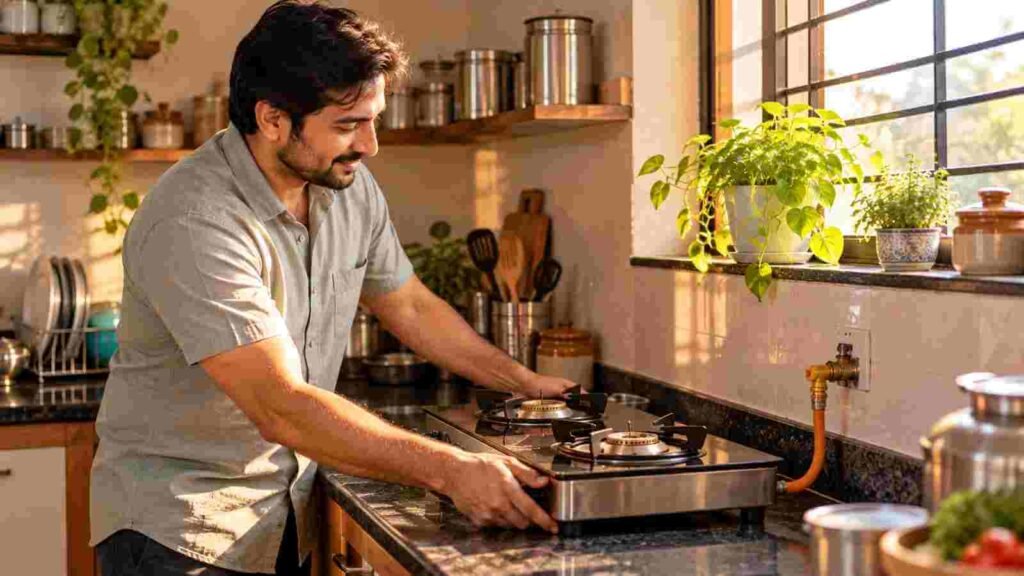
Both positions are “in the south-east corner”, and many kitchens are built with the stove on the south wall because that is where the gas line happens to run. But that arrangement has you cooking facing south, which is traditionally discouraged. The one position that satisfies both rules is the east wall, at its south end. If your stove is currently on the south side of that corner, moving it a few feet round onto the east wall keeps it in the south-east and turns you to face east.
The calculator makes this connection for you: if you tell it you cook facing south, it points you to the east wall of the same corner.
Which Direction to Face While Cooking
East is ideal — the direction of the rising sun, linked with health and positivity in the food. North is also good and associated with prosperity. West is acceptable. South is traditionally discouraged, and as shown above, it is usually the result of a stove placed on the south wall. Correcting it is often a matter of moving the stove rather than rebuilding anything.
Kitchen Layouts: Where the Stove and Sink Go in Yours
Most Indian kitchens today are modular, and the shape of the counter decides how easily the rules can be followed. The calculator gives this advice for your layout; here it is in full.
L-shaped
The layout best suited to Vastu. Its two arms can run along the east and north walls. Put the stove on the east arm, towards its south end, so you face east; put the sink on the north arm. The corner itself separates fire and water, so the most common Vastu conflict is solved by the shape.
Parallel or galley
Two facing counters with a walkway between. Put the stove and sink on different counters — but not directly opposite each other, so the person at the stove is not staring across at the sink. Offset them along the run.
U-shaped
Use the east arm for the stove and the north arm for the sink, and keep the third arm for storage and preparation. Plan gas and plumbing points early; moving them later is expensive.
Straight or single wall
The most constrained layout, because stove and sink must share one counter. Put the stove at the south or east end and the sink at the far end, as far apart as the run allows. Prioritise that separation over everything else.
Island or open kitchen
Keep the stove on a wall, not on the island. A cooktop in the middle of the room cannot sit in the south-east of the kitchen, and it faces you in a direction set by the furniture rather than the plan. Use the island for preparation or seating.
When the Sink Sits Right Next to the Stove
This is the most common kitchen Vastu problem in modern flats, and it is worth being clear about what the tradition actually says.
Fire and water are opposing elements in Vastu, so the principle is simply to keep the stove and sink apart, with the sink towards the north or north-east. That principle is old and consistent. What is not old is the specific distance you will see quoted — “two to three feet”, “at least three feet”. No classical text gives a measurement; these figures are modern rules of thumb. They are sensible, but they are not scripture, and you should not panic if your counter allows less.
If the sink and stove genuinely have to sit close on one counter, keep as much worktop between them as you can, and avoid placing them directly opposite each other across a galley.
A note on the wooden-board remedy
The most widely recommended fix is a wooden board, partition or small plant between the stove and sink, usually explained as “wood is a neutral element in Vastu that mediates between fire and water”. It is worth knowing where that reasoning comes from. Vastu’s five elements, the pancha mahabhuta, are earth, water, fire, air and space — wood is not one of them. Wood is an element in the Chinese five-element system used in feng shui, where water feeds wood and wood feeds fire, so wood sits naturally between the two. The remedy has been borrowed into Vastu from there.
That does not make it useless. A board or a plant between the two does something plainly practical: it keeps water from splashing onto the flame and defines two separate working zones. Just know that it works as a sensible physical separator, not because of a Vastu element.
Inside the Kitchen: Placement Guide
| Item | Best place in the kitchen |
|---|---|
| Gas stove | East wall, at its south-east end — cook facing east |
| Sink and drinking water | North-east, north or east — away from the stove |
| Refrigerator | South-east, south or west |
| Grains and storage | South or west walls |
| Window and exhaust | East preferred; south also acceptable for the exhaust |
| Microwave, oven, electricals | South-east, with the stove |
| Kitchen’s north-east corner | Keep light and clean — no bin, no heavy storage |
Kitchens in Flats: Above, Below and Beside
In apartments, what surrounds the kitchen matters as much as its direction. A kitchen should not share a wall with a toilet, and ideally should not sit directly above or below a toilet, a bedroom or a pooja room on the neighbouring floor. It should not face the main door directly, and the kitchen door itself is better not placed in a corner. You cannot change the building, but knowing these points helps when choosing a flat — and where the problem is with the flat above or below, keeping your own kitchen clean and well ventilated is the reasonable response.
Colours for a Kitchen
Warm, fire-supporting shades suit a kitchen — yellow, orange, soft red, warm terracotta, even as accents. Green and light earthy tones work well too. Large areas of dark blue or black are usually avoided, since they belong to the water element.
How to Fix Kitchen Vastu Without Rebuilding
- Move the stove to the east wall of the south-east corner, so you cook facing east. This is the single most effective change and often the cheapest.
- Separate the sink and stove as far as the counter allows, with a board or plant between them if they must be close.
- Keep the kitchen’s north-east corner light — move the dustbin and heavy storage out of it.
- Keep everything clean and well ventilated. A clean kitchen in an imperfect zone is traditionally better than a neglected one in the ideal zone.
- Use warm colours where you can.
For a kitchen in a genuinely difficult zone like the north-east, the same practical steps do most of the work. Be cautious of anyone selling expensive yantras, metal strips or devices to “correct” a kitchen; the effective remedies here are arrangement and cleanliness.
Common Misconceptions
- “Any stove in the south-east corner is correct.” Only on the east wall of that corner. On the south wall, you end up cooking facing south.
- “Any kitchen outside the south-east is a disaster.” The north-west and south are good options, and most placements improve with simple changes.
- “The sink must be exactly three feet from the stove.” Separation is the principle; the specific number is a modern rule of thumb, not a classical rule.
- “Wood is a Vastu element.” It is a Chinese five-element concept. The wooden-board remedy works as a practical separator.
- “An open kitchen cannot follow Vastu.” It can, if the stove stays on a wall rather than the island.
- “It is scientifically proven.” Vastu is a traditional belief system, offered here as a framework for arranging a kitchen with care.
Frequently Asked Questions
Which is the best direction for a kitchen?
The south-east (Agneya). The north-west is the best alternative, and the south and south-south-east are acceptable.
Why should a kitchen not be in the north-east?
The north-east is the most sacred water zone. Fire there is one of the most serious faults in Vastu, along with a kitchen in the south-west.
Where exactly should the gas stove go?
On the east wall of the kitchen, at its south-east end. That keeps it in the south-east corner and has you facing east while cooking — the only position that satisfies both rules.
My stove is in the south-east corner but I face south. Is that wrong?
It means the stove is on the south wall of that corner. Moving it round to the east wall of the same corner keeps it in the south-east and turns you to face east.
Which direction should I face while cooking?
East is ideal and north is good. South is traditionally discouraged.
How far should the sink be from the stove?
As far as the layout allows. Two to three feet is a common modern suggestion, though no classical text specifies a distance. Keep them apart and not directly opposite each other.
What if the sink is right next to the stove?
Keep as much counter between them as possible and use a board or plant as a buffer. That works as a practical separator; it does not need a rebuild.
Which kitchen layout is best for Vastu?
L-shaped: stove on the east arm, sink on the north arm, with the corner separating them naturally.
Can an open kitchen follow Vastu?
Yes, if the stove sits on a wall rather than the island. Use the island for preparation or seating.
What colours suit a kitchen?
Warm shades — yellow, orange, soft red, terracotta — plus green and light earthy tones. Avoid large areas of dark blue or black.
Does the kitchen Vastu calculator really work?
It identifies your zone reliably and applies traditional Vastu consistently, checked against our verified sixteen-zone reference. The guidance itself is traditional belief rather than proven science.
Related Vastu Tools and Guide
For every room in one place, read our Vastu Directions Guide. You can also continue with:
- Vastu Score Calculator — the kitchen is one of ten placements in your whole-home score.
- Toilet Vastu Calculator — the room a kitchen must not share a wall with.
- Pooja Room Vastu Calculator — the other room to keep apart from the kitchen.
- Bedroom Vastu Calculator — room and sleeping direction.
Kitchen in the south-east, stove on the east wall, face east, sink to the north-east and kept apart — that is nearly all of kitchen Vastu, and most of it can be done without touching a wall.
This information is based on traditional Vastu Shastra principles and is intended for general guidance and self-reflection, not as a substitute for professional architectural or Vastu consultation. Read our full Disclaimer for more.