
Bedroom Vastu Calculator: A bedroom is where we rest and recover, so Vastu gives it careful attention — both the zone the room sits in and the direction your head points while you sleep. But the right zone depends on whose room it is. What suits a couple’s master bedroom is wrong for a child’s room, and a guest room follows its own logic again.
The calculator checks all four room types against the sixteen zones, and your sleeping direction too. Below, you will find the four zones no bedroom should use, a zone-by-zone table for every room type, and something most bedroom Vastu pages skip: an honest look at the famous “never sleep with your head to the north” rule — what the tradition says, and what the science its popular explanation borrows actually shows.
Bedroom Vastu Calculator Online Free
Bedroom Vastu Calculator
Check your bedroom’s zone on the 16-zone system by room type, plus your sleeping direction.
Please select the room type and the zone your bedroom is in.
The short answer: Master bedroom — South-West · Children — West, North-West, East, North, or West-South-West for a study-bedroom · Guest — North-West · No bedroom at all in the North-East, South-East, East-South-East or West-North-West · Sleep with your head to the South or East.
Why Bedroom Direction Matters in Vastu
Vastu treats each of the sixteen zones as carrying an element and governing an area of life, and a bedroom works best where the zone’s quality supports rest. The south-west, ruled by earth, is the heaviest and most grounding part of a home — the settled energy a bedroom needs. Light, fiery or restless zones are held to bring the opposite.
There is a practical logic underneath, too. The south-west takes the strong afternoon sun and holds warmth into the evening, giving it a settled, cocooning quality, while the north-east stays cool and bright — better for morning activity and prayer than for sleep. As so often in Vastu, the traditional rule and everyday good sense point the same way.
Four Zones No Bedroom Should Use
Before looking at who sleeps where, start with the four zones that are wrong for every bedroom, whoever uses it. The verified sixteen-zone framework rules out each of them:
| Zone | What it governs | Why no bedroom belongs here |
|---|---|---|
| North-East | Clarity, the sacred | Kept for prayer and meditation — a strict avoid for any bedroom |
| South-East | Fire, energy | The fire zone; linked with restlessness and friction |
| East-South-East | Anxiety, churning | The tradition specifically warns that a bedroom here brings disagreements and unrest |
| West-North-West | Stress, letting go | The zone recommended for a toilet — not a place to sleep |
This matters because an earlier version of our own calculator got it wrong. It rated the east-south-east and west-north-west “acceptable” for all four room types, and the north-east “acceptable” for children’s and daughters’ rooms. All four zones are now marked to avoid for every room type, with the north-east flagged as a strict avoid.
The West-North-West: a label that pointed the wrong way
One small detail on the old page caused a real problem. It described the west-north-west as the zone of “detox and rest“. On a bedroom page, “rest” is exactly the word that makes someone think they have found a good bedroom zone. In fact, in the sixteen-zone system this is the zone of stress and depression — the zone whose job is to let things go, which is why it is the best place in the house for a toilet. The label now reads “stress and detox”, and the calculator explains why no bedroom should be there.
The Master Bedroom
The master bedroom belongs to the couple who head the household, and its placement matters most. The south-west (Nairutya), the zone of relationships and stability, is ideal. The south-south-west, west-south-west, south and west share its heavy, settled quality and work well too.
Two zones sit in between. The north-west is acceptable. The north-north-west, the zone of attraction, is traditionally regarded as suitable for a couple’s room — which is also why it is kept away from children.
The north and east are best avoided for the master bedroom. That is not because they are bad zones — they are bright, fresh and full of growth — but because the tradition keeps them for children and young people. The heavier, settled zones belong to the parents.
| Zone | Master bedroom verdict |
|---|---|
| South-West | Ideal |
| SSW, WSW, South, West | Well placed |
| North-West, NNW | Acceptable — NNW traditionally suits a couple |
| North, NNE, East, ENE | Best avoided — kept for children |
| South-East, SSE | Best avoided — fire zone |
| ESE, WNW | Best avoided — anxiety and stress zones |
| North-East | Strictly avoid |
The Children’s Bedroom
Children’s rooms suit the brighter, livelier half of the home: the west, north-west, east and north, plus the east-north-east. The east and north are fresh, energising zones that support growth and study.
One zone deserves special mention. The west-south-west is the zone of education and study in the sixteen-zone system — which makes it especially good for a room that doubles as a study, and for placing a child’s study desk. Our old calculator did not recognise this; it now rates the west-south-west as ideal for children.
Keep children out of the fiery south-east and south-south-east, out of the heavy south-west (traditionally the parents’ zone), and out of the north-north-west, the zone of attraction that the tradition reserves for a couple.
| Zone | Children’s bedroom verdict |
|---|---|
| West, North-West, East, North, ENE | Well placed |
| West-South-West | Well placed — especially for a study-bedroom |
| NNE, South, SSW | Acceptable |
| South-East, SSE | Best avoided — fire zone |
| South-West | Best avoided — the parents’ zone |
| NNW | Best avoided — reserved for a couple |
| ESE, WNW | Best avoided — anxiety and stress zones |
| North-East | Strictly avoid |

The Guest Bedroom
The north-west is the traditional guest zone. It is the zone of Vayu, the air element — movement and change — which matches the temporary nature of a guest’s stay; the old saying is that guests placed here do not overstay. The west and south are also good. Beyond the four zones no bedroom should use, the guest room is flexible: most other zones are acceptable.
The Unmarried Daughter’s Room
Traditional Vastu gives this room its own guidance: the north-west is considered especially suitable, with the west and north also good, and the south-west is traditionally avoided — its heavy, settling energy is said to hold things in place. The four zones no bedroom should use apply here too.
We give this as the tradition gives it, because it is one of the most searched bedroom questions. But it is worth saying plainly: no room placement decides when, or whether, anyone marries. Treat this as a matter of arranging a room with care, not as a lever on anyone’s future.
The Correct Sleeping Direction
Along with the room itself, Vastu gives a clear rule for the direction your head points while you sleep.
| Head points towards | Traditional verdict |
|---|---|
| South | Preferred |
| East | Very good — especially for students |
| West, South-West, South-East, North-West | Acceptable |
| North-East | Traditionally avoided |
| North | Traditionally avoided |
In practice that means placing the bed so its headboard is against the south or east wall, with your feet towards the north or west. If your bed currently points north, turning it is one of the easiest changes in all of Vastu — it needs no construction, only a little rearranging.
Why “Never Head North”? The Magnetic Explanation, Checked
Almost every bedroom Vastu guide explains the head-north rule the same way: the Earth has a magnetic field, the body has one too, and sleeping with your head to the north makes them clash — disturbing sleep, straining circulation and, over time, harming health. In Hindi the question is usually searched as sone ki sahi disha, often with the words “scientific reason” attached. Since the explanation is presented as science, it is fair to check it as science.
What the numbers say
- The Earth’s magnetic field is weak. At the surface it measures roughly 25 to 65 microtesla — strong enough to swing a light compass needle, and not much more.
- Hospital MRI scanners use fields of 1.5 to 3 tesla — tens of thousands of times stronger than the Earth’s. People lie inside them, in every orientation, for up to an hour, without their blood being pulled or their circulation disturbed.
- The iron in your blood is not magnetic like a compass needle. It is bound inside haemoglobin molecules, and in that form it does not behave like the iron in a nail or a magnet. There is nothing in the blood for the Earth’s field to grip.
- Some versions even get the direction backwards. A common line says the field “flows from north to south”. At the Earth’s surface it runs the other way — which is exactly why a compass needle points north.
We know of no good-quality evidence that the direction of your head affects sleep, circulation or health. The rule itself is old. The magnetic explanation is not: the classical texts could not have used it, since they long predate the discovery that the Earth itself behaves like a magnet. It was added in modern times to make a traditional rule sound scientific.
So what should you do?
Keep the tradition if it suits you — it is completely harmless and costs nothing. Many people simply feel more settled sleeping with their head to the south or east, and there is no reason to stop. But hold it as a tradition rather than a health rule. Do not rearrange a small room into an awkward layout to avoid a north-facing bed, do not lose sleep worrying about it, and be wary of anyone who tells you a north-facing bed is causing illness or money trouble — especially if the same person then sells you a remedy for it.
Bed, Mirror and Furniture Placement
The bed
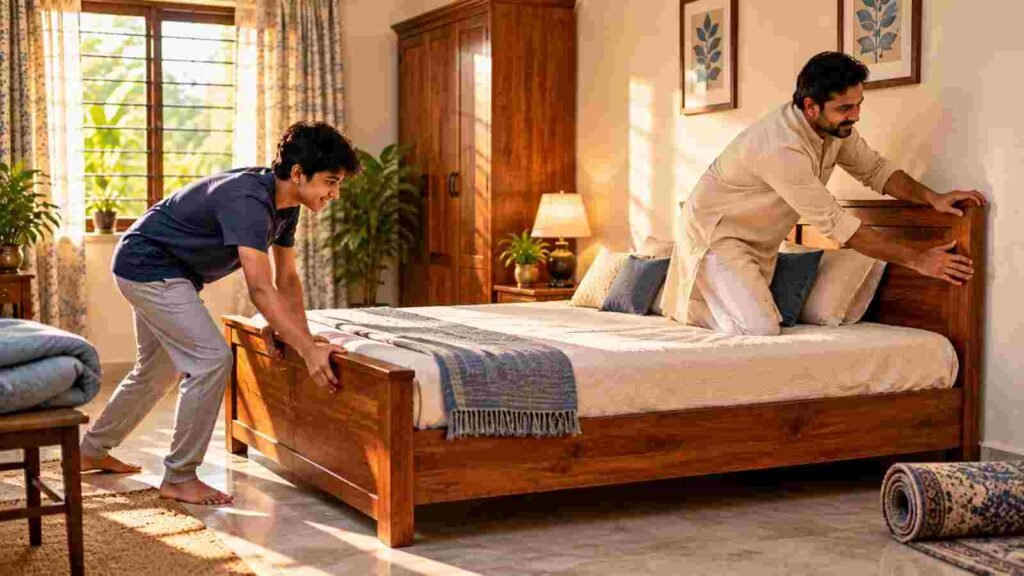
Place the bed with its headboard against a solid wall — not a window, and not floating in the middle of the room. Within the room, the south-west part is the traditional place for the bed. Keep it out of direct line with the door, never directly under a beam, and not pushed tight into a corner: leave space around it to move freely. A simple, regular bed shape is preferred, and the space underneath is best kept clear rather than packed with shoes and clutter.
Heavy furniture
The south-west corner of the room should be its heaviest part. Wardrobes and heavy storage belong along the south or west walls, keeping the north-east of the room light and open.
Mirrors and electronics
A mirror or dressing table should not reflect the bed. If it does, cover it at night or move it. Keep electronics to a minimum — a television is best avoided in the bedroom or kept covered — and leave water features, fountains and aquariums out of the room altogether.
A study desk in the bedroom
For a child or student whose bedroom is also their study, place the desk so they face north or east while working. In the sixteen-zone system, the west-south-west part of the room is the zone of study.
Colours for the Bedroom
Vastu favours soft, calming shades for a room meant for rest. For a south-west master bedroom, warm earthy tones — light brown, beige, cream, soft terracotta — suit the earth element. Gentle pastels such as light pink, soft green and pale blue work in most bedrooms. Large areas of bright red or black are best avoided as too stimulating. For children’s rooms, fresh greens and blues support both study and calm.
Door, Windows and Ventilation
A bedroom door is best on the north, east or north-east wall of the room, opening smoothly and fully. Windows on the north or east let in gentle morning light; heavier curtains on the west soften the afternoon sun. Keep the room well ventilated, avoid a bedroom door facing a toilet door or the kitchen, and keep the bed out of direct line with the door.
Attached Bathrooms
An attached bathroom follows the toilet rules within the bedroom: the west-north-west, south-south-west or east-south-east corner of the room is best, and the north-east and south-west corners should be avoided. Keep the bathroom door closed, and ideally not directly facing the bed. Our Toilet Vastu Calculator covers this in detail.
Remedies for a Bedroom in the Wrong Zone
Rooms usually cannot move, but a great deal can still be done:
- Swap rooms if you can. Often the simplest fix is a change of use — moving the couple into the south-west room and giving the north or east room to the children.
- Turn the bed so the headboard rests against a solid south or east wall.
- Keep the room’s own south-west corner heavy with the bed and wardrobe, and its north-east corner light.
- Use calming colours — especially cooling shades in a south-east bedroom, to balance the fire zone.
- Keep the room clean, uncluttered and well ventilated.
Be cautious of anyone selling yantras, crystals or devices to “correct” a bedroom. The genuine remedies here are rearrangement and change of use, and they cost nothing.
Common Misconceptions
- “Sleeping with your head north causes illness.” There is no good evidence for this. The Earth’s magnetic field is tens of thousands of times weaker than an MRI scanner’s.
- “The west-north-west is a restful zone.” It is the stress zone — the best place for a toilet, not a bed.
- “North and east bedrooms are bad.” They are good for children and young people; they are only avoided for the master bedroom.
- “Any bedroom is fine in the east-south-east.” It is the zone of anxiety, and the tradition specifically warns against a bedroom there.
- “A daughter’s room decides when she marries.” The tradition offers guidance on placement; it does not decide anyone’s future.
- “Vastu is scientifically proven.” It is a traditional belief system, offered here as a framework for arranging a home with care.
Frequently Asked Questions
Which direction is best for the master bedroom?
The south-west. The south-south-west, west-south-west, south and west also work well, and the north-north-west is traditionally suitable for a couple.
Which zones should no bedroom use?
The north-east (strictly), the south-east, the east-south-east and the west-north-west — for any room type.
Which direction should I sleep in?
With your head to the south, or to the east. The north is traditionally avoided.
Is there a scientific reason not to sleep with my head to the north?
Not a good one. The popular magnetic explanation does not hold up: the Earth’s field is very weak, the iron in blood is not magnetic like a compass needle, and people lie in MRI fields tens of thousands of times stronger without effect. The tradition is harmless to follow, but it is a tradition rather than a health rule.
Which direction is best for a children’s bedroom?
The west, north-west, east or north. The west-south-west is especially good for a room that doubles as a study.
Can children use the south-west room?
Traditionally not — the south-west is reserved for the parents. Children do better in the brighter zones.
Where should a guest bedroom be?
In the north-west, the zone of movement, which suits a temporary stay. The west and south also work.
Which direction suits an unmarried daughter’s room?
Traditionally the north-west, with the west and north also good; the south-west is traditionally avoided. No room placement decides anyone’s marriage.
Can the bedroom be in the north-east?
No. The north-east is kept for prayer and clarity, and it is a strict avoid for every bedroom.
Is a mirror facing the bed bad?
Traditionally, yes. Move it or cover it at night.
Does the bedroom Vastu calculator really work?
It identifies your zone reliably and applies traditional Vastu consistently, checked against our verified sixteen-zone reference and matched to our Vastu Score calculator. The guidance itself is traditional belief rather than proven science.
Related Vastu Tools and Guide
For every room in one place, read our Vastu Directions Guide. You can also continue with:
- Vastu Score Calculator — the master bedroom is one of ten placements in your whole-home score.
- Toilet Vastu Calculator — including attached bathrooms.
- Pooja Room Vastu Calculator — the north-east’s proper use.
- Kitchen Vastu Calculator — the south-east’s proper use.
Parents in the south-west, children in the brighter zones, guests in the north-west, and nobody in the four zones no bedroom should use. Sleep head-south or east if it suits you — and rest easy either way.
This information is based on traditional Vastu Shastra principles and is intended for general guidance and self-reflection, not as a substitute for professional architectural or Vastu consultation. Read our full Disclaimer for more.