

Pooja Room Vastu Calculator: The pooja room is the quiet centre of an Indian home — the corner where the day starts with a lamp and ends with a prayer. Vastu holds that where this space sits, and which way you face inside it, shapes the calm it brings to the whole household.
The calculator below uses the sixteen-zone system to check your mandir’s position, the direction you face while praying, and the three placement problems that cause more trouble in Indian flats than direction ever does. Below it, you will also find the one question almost every pooja room guide gets tangled in — which way the idols should face — worked out properly for the first time.
Online Pooja Room Vastu Calculator Free
Pooja Room Vastu Calculator
Check your mandir’s zone (16 directions), the direction you face while praying, and the placement problems that matter most in Indian homes.
Please select the zone your pooja room is in.
The short answer: Ideal — North-East (Ishanya) · Excellent — North, East, NNE, ENE · Acceptable — West, WSW, North-West · Avoid — the south belt, and three zones most calculators wrongly allow (WNW, NNW, ESE) · Face East while praying, so the idols face West.
Why the Pooja Room’s Position Matters
Vastu divides a home into zones, each tied to an element and an area of life. A mandir belongs where the energy is light, clear and rising — which is why the north-east, the zone of clarity and wisdom, is its natural home. Placed in a heavy or disruptive zone, the space is held to feel restless rather than settled, whatever the devotion inside it.
The Sacred North-East (Ishanya)
The north-east is called Ishanya, after a form of Lord Shiva, and it is the most sacred zone in any building. It sits where the north axis (Kubera, prosperity) meets the east axis (sunrise, new energy), and it is governed by water — clarity, flow and calm. It is the one zone where worship of any deity is considered appropriate, and it should be kept clean, light and uncluttered whatever it is used for.
Why 16 Zones and Not 8
Most guides work with eight directions. The sixteen-zone system splits each into two, giving zones of 22.5 degrees each, and the difference is not academic. North-west is an acceptable spot for a mandir; the zone immediately next to it, west-north-west, is one of the worst. An eight-direction tool cannot tell those apart. This one can, and that distinction is exactly where most calculators go wrong.
All 16 Zones for a Pooja Room
| Zone | Verdict | Why |
|---|---|---|
| NE — Ishanya | Ideal | Zone of clarity and wisdom; suits every deity |
| N — North | Excellent | Kubera’s direction; traditionally Lakshmi and Ganesha |
| E — East | Excellent | The rising sun; general daily worship |
| NNE | Excellent | Health and immunity; traditionally Dhanvantari |
| ENE | Excellent | Refreshment and renewal |
| W — West | Acceptable | A workable alternative when the north-east belt is unavailable |
| WSW | Acceptable | Zone of learning; suits Saraswati worship |
| NW — Vayavya | Acceptable | Traditionally the zone of ancestral (Pitra) worship |
| WNW | Avoid | MahaVastu’s zone of stress and depression — the best zone for a toilet |
| NNW | Avoid | MahaVastu’s zone of attraction and sensual enjoyment |
| ESE | Avoid | Zone of anxiety and churning |
| SE — Agneya | Avoid | Fire zone; associated with Durga worship only |
| SSE | Avoid | Associated with Hanuman worship specifically |
| SSW | Avoid | Zone of disposal |
| S — South | Strictly avoid | Yama’s direction; no workaround in any school |
| SW — Nairutya | Strictly avoid | The heaviest zone; no workaround in any school |
Three zones most calculators get wrong
Look at the three bolded “Avoid” rows in the middle of that table. Many online tools — including an earlier version of this one — mark west-north-west, north-north-west and east-south-east as “acceptable” for a mandir. They are not, and the reason is worth understanding.
In the MahaVastu framework these three zones govern the opposite of what a mandir is for. West-north-west is the zone of rodhan — stress, depression and the release of negativity. It is literally the zone Vastu recommends for a toilet or a septic tank, because it helps carry unwanted things out. North-north-west is the zone of attraction and sensual enjoyment. East-south-east is the zone of anxiety and mental churning. MahaVastu-based teaching specifically says general worship should be avoided in all three.
The contradiction is easy to see once it is laid out. A calculator that allows a mandir in WNW is, by its own zone definitions, telling you to put your prayer space in the toilet’s best location. We have moved all three to “Avoid”.
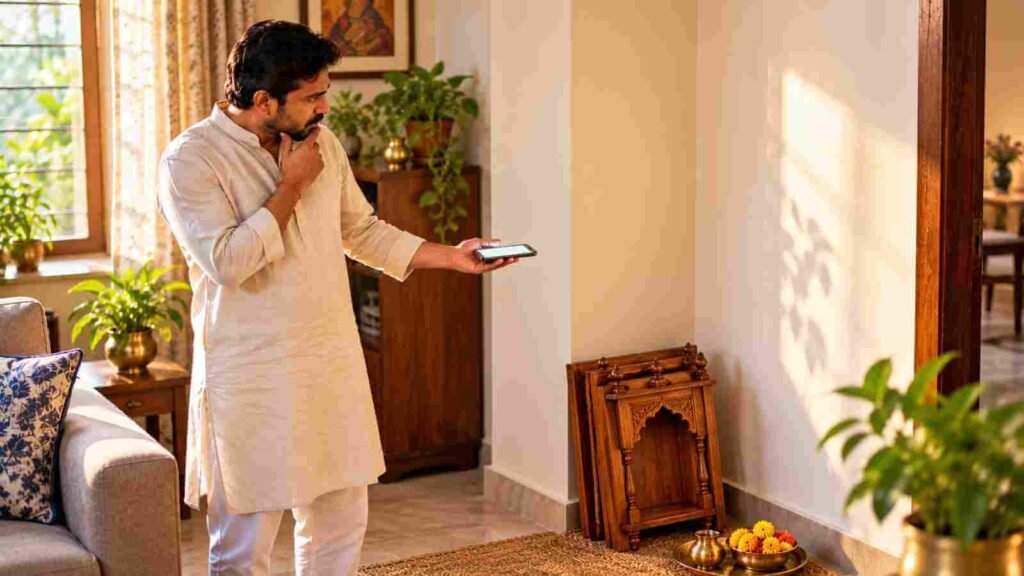
Which Way Should the Idols Face? The Two Rules That Collide
This is the question pooja room guides answer most confidently and most inconsistently, and there is a reason for that. Two popular Vastu rules are usually stated side by side, and they cannot both be followed in every direction.
Rule A: the worshipper should face east or north while praying.
Rule B: the idols should face east or west — and never south, the direction of Yama.
Both are widely repeated, and both have good traditional grounds. The problem is geometry. When you sit facing an idol, the idol faces you, so it points in exactly the opposite direction. Follow Rule A by facing north, and your idol necessarily faces south — breaking Rule B. Here is every combination:
| You face | So the idol faces | Rule A (you: east or north) | Rule B (idol: east or west) |
|---|---|---|---|
| East | West | ✓ | ✓ |
| West | East | ✗ | ✓ |
| North | South | ✓ | ✗ |
| South | North | ✗ | ✓ |
Only one arrangement satisfies both rules: you face east, and the idols face west. That is the answer to give without hesitation, and it is the one the calculator marks as ideal.
After that, the honest ranking is less obvious than most guides suggest. Facing west breaks Rule A but satisfies Rule B, and puts the idols facing east — which many sources consider the single most auspicious direction for an idol to face. Facing north satisfies Rule A but turns the idols to face south, which nearly every source advises against for a home mandir. So by the idol rule, west is actually the better second choice, even though north is the one usually recommended.
A common shortcut you will see — “face east or north, so the idols face west or south” — is exactly this collision stated as if it were fine. An earlier version of this page said the same thing. It recommends a south-facing idol in the same breath as the rule forbidding one.
A reasonable closing note: temple traditions across India are diverse, and certain deities in certain temples face south deliberately. For a home mandir, though, the safe and nearly universal advice is to keep the idols facing east or west, which in practice means facing east yourself.
Which Deity Suits Which Zone
This is a layer most calculators leave out, and it matters because Indian households usually worship particular deities rather than worship in general. MahaVastu-based teaching links specific zones with specific forms of worship:
| Zone | Traditionally associated with |
|---|---|
| North-East | All deities — the universal zone for worship |
| North | Lakshmi and Ganesha |
| North-North-East | Dhanvantari; prayers for health |
| East | Surya and general daily worship |
| West-South-West | Saraswati; learning and study |
| North-West | Pitra — ancestral worship |
| South-East | Durga specifically |
| South-South-East | Hanuman specifically |
| South | Kali specifically |
Two cautions. First, this is one tradition’s teaching, not a rule shared by every school, so treat it as enrichment rather than a verdict. Second, the south-belt entries do not make those zones good places for a family mandir — they mean that one specific form of worship is associated with them, while general worship there is still discouraged. For a household shrine used for everyday prayer, the north-east remains the answer.
Where a Mandir Should Never Be
In real Indian homes, and especially in flats, these three problems come up far more often than a wrong zone does — which is why the calculator now asks about them directly.
Next to, above or below a toilet. This is the one placement every source agrees is wrong. A mandir should never share a wall with a toilet, nor sit directly under or over one on another floor. The good news is that it is usually the easiest to fix: moving the mandir to a different wall, even within the same room, solves it completely.
Inside a bedroom. Best avoided, and the master bedroom especially. In a one-bedroom flat this is sometimes unavoidable; if so, place it in the north-east corner of the room, raised off the floor, and keep it curtained or closed when not in use.
Under a staircase or a heavy beam. Traditionally avoided because of the weight pressing down on the sacred space. A small wall-mounted mandir elsewhere is the usual answer.
Also avoid a store room, a basement, or any position below ground level.
Idol and Mandir Placement
Placing the idols
Keep idols about an inch away from the wall rather than pressed flat against it, and never directly on the floor — a chowki, pedestal or raised shelf is correct. Idols should not face each other, and should not look straight out through the mandir’s door. Remove broken or chipped idols, and avoid keeping several idols of the same deity in a small home shrine. For compact home mandirs, idols of three to six inches are typical.
Lamp, height and distance
Keep the diya in the south-east of the mandir — its fire zone. The main idols should sit at roughly eye level or slightly above when you are seated, so the worshipper is a little below the deity. Leave space around the idols so the mandir does not feel crowded.
Pooja Room Vastu for Flats and Small Homes
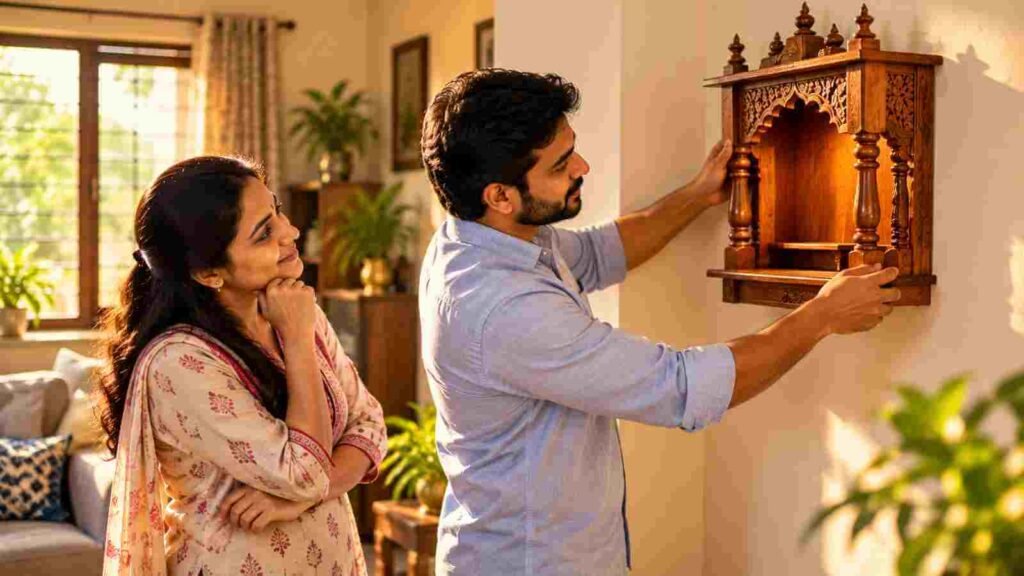
Most Indian households, particularly in one- and two-bedroom flats, do not have a separate pooja room — and they do not need one. A small mandir on the north-east or east wall of the living room works well. Mount it on a wall shelf or wooden unit above floor level, keep it away from the bedroom and bathroom, and check that there is no kitchen or toilet directly above it from the flat upstairs. That last check is the one people forget, and in stacked apartments it matters.
Colours, Materials and Lighting
Light, calm colours suit a mandir — white, cream, pale yellow, light blue or a soft sandalwood tone. Wood and marble are the most recommended materials. Natural light from the north or east is ideal, with a soft lamp for aarti, and good ventilation matters. Avoid dark, heavy colours and harsh lighting, and keep the space scrupulously clean, since cleanliness is central to the atmosphere of a mandir.
What to Keep in the Mandir, and What Not To
Keep only what belongs there: idols or images of your chosen deities, a diya, an incense holder, a small bell, holy books, and fresh flowers or water. Avoid broken idols, photographs of deceased relatives inside the main mandir (these traditionally go on a south or south-west wall elsewhere), money or valuables stored in the shrine, and clutter beneath or around it. Remove dried flowers and stale offerings promptly. A simple, uncrowded mandir holds its calm far better than a full one.
Daily Care
Lighting a lamp morning and evening, offering fresh water and flowers, and keeping the space swept are what keep a mandir alive. Brahma Muhurta, the hours before sunrise, is traditionally the most auspicious time for prayer, though sincere worship at any hour is equally valued. These small acts of care matter at least as much as the mandir’s direction.
Remedies for a Mandir in the Wrong Place
There is no need for anxiety about any of this. The simplest remedy is almost always to move the mandir to a north-east, north or east wall — often a matter of shifting one shelf. If the location genuinely cannot change, rearrange so that you face east while praying and the idols face west; keep the lamp in the south-east of the mandir; keep the space bright, clean and uncluttered; and move it off any wall shared with a toilet, which is the single change that matters most.
Be wary of anyone who tells you a mandir in the wrong corner is the cause of your family’s difficulties and then offers an expensive remedy for it. Vastu is a traditional framework for arranging a home with care, not a diagnosis, and the fixes it recommends are nearly always free.
Common Misconceptions
- “Face east or north, so the idols face west or south.” This recommends a south-facing idol, which the same tradition forbids. Face east, with the idols facing west.
- “Any north-western zone is fine.” North-west is acceptable; west-north-west, right next to it, is the toilet zone. The 16-zone distinction matters.
- “West is a bad direction for worship.” Facing west puts the idols facing east, which many sources consider the most auspicious idol direction.
- “A mandir in the wrong zone brings misfortune.” It is a matter of arrangement, not punishment, and it is almost always easy to adjust.
- “Every home needs a separate pooja room.” A small wall mandir in the north-east of the living room is entirely sufficient.
- “It is scientifically proven.” Vastu is a traditional belief system, offered here as guidance for arranging your home with care.
Frequently Asked Questions
Which direction is best for a pooja room?
The north-east (Ishanya) is ideal. North, east, NNE and ENE are excellent alternatives. West, WSW and north-west are acceptable if none of those are available.
Which direction should I face while praying?
East. It is the only direction that satisfies both the worshipper rule and the idol rule, because the idols then face west. West is the next best choice, since the idols then face east.
Which direction should the idols face?
West or east, and never south. In practice that means facing east yourself (idols face west) or facing west (idols face east).
Is facing north while praying wrong?
It is widely recommended for the worshipper, but it means the idols face south, which most sources advise against for a home mandir. If you can, arrange things so you face east instead.
Why do some guides say “face east or north”?
Because two traditional rules are usually stated together without noticing that they collide. Facing north satisfies the worshipper rule but breaks the idol rule. Facing east satisfies both.
Can the pooja room be in the north-west?
North-west itself is acceptable, and is traditionally associated with ancestral worship. But west-north-west and north-north-west, the zones on either side of it, should be avoided.
Why is WNW bad for a mandir when other calculators say it is fine?
In MahaVastu, WNW is the zone of stress and depression, and the best location for a toilet. Allowing a mandir there contradicts the zone’s own definition. We corrected this on our own calculator too.
Can the mandir be in the bedroom?
Best avoided. If there is no alternative, keep it in the north-east corner of the room, raised off the floor, and curtained when not in use — and not in the master bedroom if it can be helped.
Can a mandir share a wall with a toilet?
No — this is the one placement every source agrees is wrong. Moving it to another wall fixes it completely.
Which deity should I place in which direction?
MahaVastu teaching links north with Lakshmi and Ganesha, NNE with Dhanvantari, WSW with Saraswati and north-west with ancestral worship. For a general family mandir with several deities, the north-east suits all of them.
What should not be kept in the pooja room?
Broken or chipped idols, photographs of deceased relatives, stored money or valuables, and dried flowers or stale offerings.
Does the pooja room Vastu calculator really work?
It reliably identifies your mandir’s zone and applies traditional Vastu guidance consistently, but that guidance is a belief system rather than proven science. Use it to arrange the space with care.
Related Vastu Tools and Guide
For every room in one place, read our Vastu Directions Guide. You can also continue with:
- Vastu Direction Calculator — find which way your home faces first.
- Toilet Vastu Calculator — the other half of the most common mandir problem.
- Bedroom Vastu Calculator — useful if the mandir has to share a bedroom.
- Vastu Score Calculator — check your whole home.
A mandir in the north-east, faced from the east, kept clean and lit — that is most of pooja room Vastu, and none of it costs anything. Make the changes you easily can, and let the space be peaceful rather than a source of worry.
This information is based on traditional Vastu Shastra principles and is intended for general guidance and self-reflection, not as a substitute for professional architectural or Vastu consultation. Read our full Disclaimer for more.